AI Hallucinations and Quality and Security Gates
- Home
- AI Hallucinations and Quality and Security Gates

A factual error is a materially false assertion under the relevant world state and time. An unsupported claim may be true, but it lacks adequate support in the designated evidence. A context-faithfulness failure misrepresents supplied material. A reasoning failure violates a required inference or calculation. An instruction failure concerns the applicable instruction hierarchy. An unauthorized request should be refused; refusal itself is not hallucination. [1]
A useful quality specification therefore names the selected failure events instead of treating every undesirable output as one label.
Q = H_factual ∨ H_support ∨ H_context ∨ H_instruction ∨ H_logical
These categories can overlap, but the overlap should be explicit. The same answer can be factually wrong and unsupported. A different answer can be factually correct yet disclose confidential information. Security violations belong in a separate contract.
Model behavior depends on training data, objectives, decoding, retrieved evidence, tools, application logic, permissions, and the current state of the world. A better model can remove some errors without repairing stale records, weak access controls, or an unsafe execution path. The relevant unit of analysis is therefore the deployed system, not the language model in isolation.
The main failure surfaces and their appropriate responses can be separated as follows.
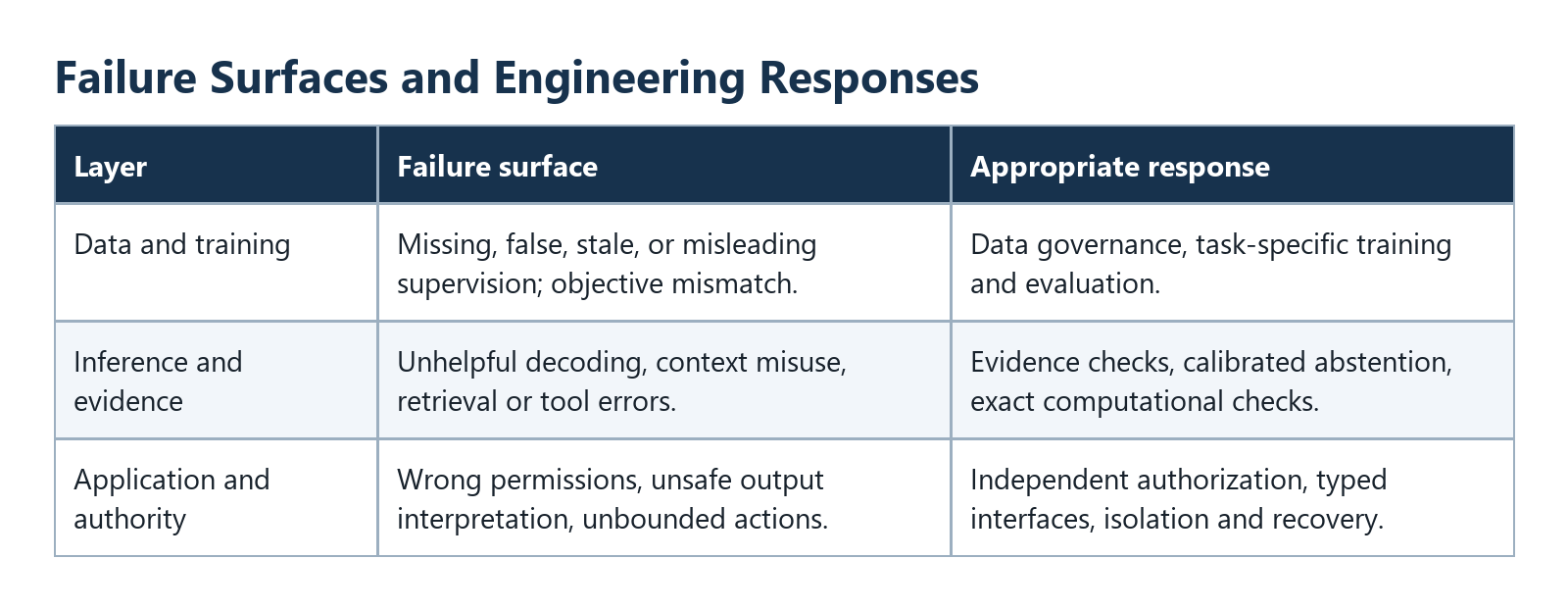
Quality gates decide whether an answer is fit for its intended use. They can validate structure, recompute arithmetic, check citations against evidence, ask for revision, narrow a claim, or withhold an answer when support is insufficient. Published work shows that retrieval, claim-level checking, semantic uncertainty, and revision can improve selected factuality measures, but the result depends on the task, evidence, model, and evaluation method. [9][12]
Security gates enforce confidentiality, integrity, authorization, isolation, and accountability. They determine which records the system may read, which operations it may request, and whether a human must approve a consequential action. These boundaries belong in conventional application and access-control code. A prompt asking the model to behave safely is useful guidance, but it is not an authorization boundary. [7][8][18]
Consider an assistant that recommends deleting a database table. A quality check may reject the recommendation. Independently, a read-only database role can prevent the deletion. The recommendation can remain wrong while the destructive capability is absent. Quality reduces bad answers; security limits what bad or malicious requests can do.
Suppose a candidate answer has raw failure probability h. A gate blocks a failed answer with probability s and blocks a clean answer with probability f. The probability of a bad release and the total release coverage are:
C = h(1 − s) + (1 − h)(1 − f), B = h(1 − s)
At positive coverage, the failure rate among released answers is:
P(H | pass) = h(1 − s) / [h(1 − s) + (1 − h)(1 − f)]
This equation exposes the real trade-off. A gate improves released-answer quality when it blocks failed answers more often than clean ones. It can also make the apparent error rate look small by refusing almost everything. Coverage must therefore be reported with risk. If nothing is released, conditional release risk is undefined, not zero.
More Gates Do Not Automatically Multiply Reliability
Sequential gates are often treated as independent filters. That assumption is dangerous. Two checkers may use the same evidence, share training patterns, or repeat the same misconception. The exact pass probability among failed answers follows the chain rule:
α_H = ∏ᵢ₌₁ᵐ P(Aᵢ | H, A₁, …, Aᵢ₋₁)
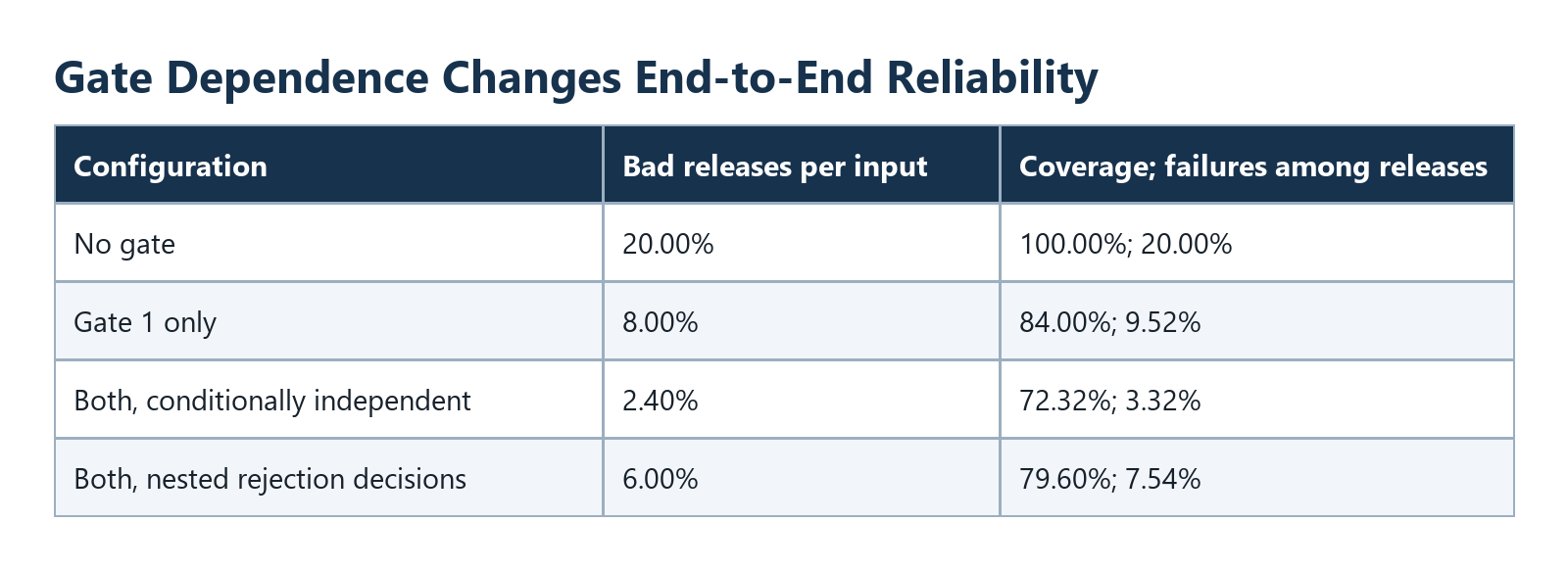
Each term must be measured on the cases that actually reach that gate. Multiplying standalone scores is justified only when the relevant conditional independence holds, or when each reported score already conditions on upstream passage. Different vendors, prompts, or random seeds do not prove independence. [9]
The source paper includes a simple numerical example. With a 20 percent raw failure rate and two gates, the same marginal gate scores produce materially different end-to-end results depending on their dependence structure.
A system cannot guarantee a definite correct answer when decisive information is unavailable to the entire pipeline. Imagine an invoice assistant asked at 10:00 whether an invoice has been paid. Its latest authorized record, from 08:00, says unpaid. Payment may or may not have occurred after that snapshot. Re-reading the same record, sampling another answer, or asking a second model cannot reveal the missing event.
The system can obtain a current observation, report only that the 08:00 record says unpaid, or abstain. The contradiction arises only when the system is required to make a definite assertion about an unresolved fact while also guaranteeing correctness. The theoretical literature supports conditional limits under stated assumptions; it does not establish that every restricted service must release hallucinations. [3][28][32]
Narrow guarantees remain possible. A typed arithmetic service can validate integer operands and compute an exact sum. A proof checker can validate a proof relative to its formal specification and trusted kernel. A read-only capability can rule out a specified write operation. Conformal factuality research also provides restricted statistical guarantees under exchangeability and reference-entailment assumptions. [27]
A defensible architecture separates probabilistic reasoning from trusted enforcement. The model proposes answers or typed actions. Conventional software determines identity, access, policy, validation, approval, execution, and audit. No model output should bypass that second path when it crosses a permission boundary.
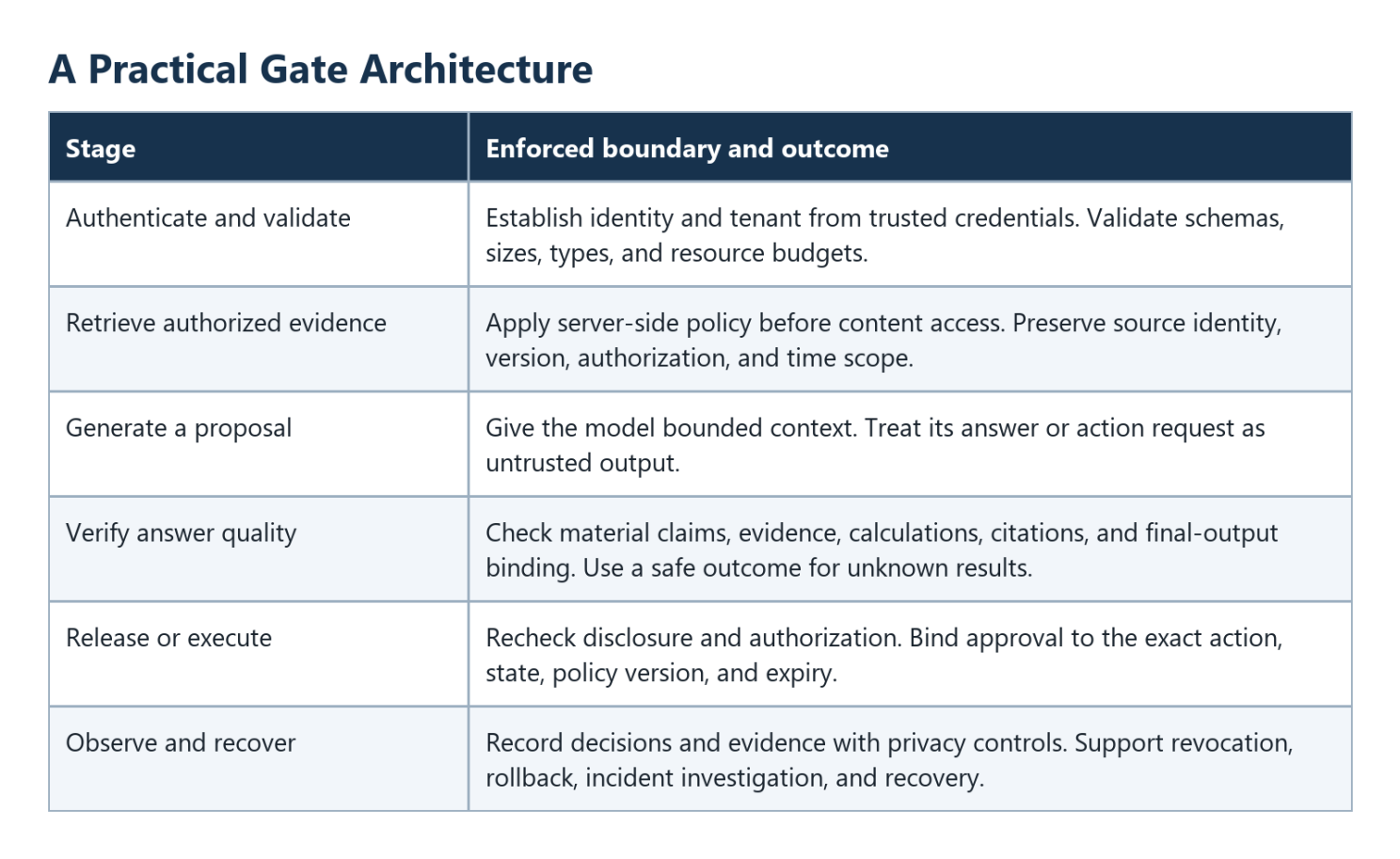
The release decision should be tied to observable evidence. At minimum, the owner should be able to answer these questions:
AI reliability is not a single percentage and a passed test is not a universal certificate. A useful assurance statement names the property being checked, the evidence and assumptions, the tested population, the release coverage, the enforcement boundary, and the uncertainty that remains.
For low-impact creative work, the system may permit exploration while clearly labeling untested ideas. For factual research, it should bind claims to evidence and state uncertainty. For consequential actions, it should use typed interfaces, least privilege, explicit approval, isolation, and recovery. The controls should become stronger as the cost of error rises.
The right commitment is practical: define what the system may claim and do, verify what can be verified, stop when evidence is insufficient, and measure and contain the risk that remains.
[1] Huang, L., et al. (2024). A Survey on Hallucination in Large Language Models: Principles, Taxonomy, Challenges, and Open Questions. arXiv:2311.05232, v2. Taxonomy source; not an empirical estimate for this deployment.
[3] Kalai, A. T., and Vempala, S. S. (2024). Calibrated Language Models Must Hallucinate. arXiv:2311.14648, v3. Corollary 1 and its world-distribution/calibration assumptions.
[7] OWASP Gen AI Security Project (2025). LLM01:2025 Prompt Injection. Threat and mitigation guidance; accessed 9 September 2026.
[8] National Institute of Standards and Technology (2020). Security and Privacy Controls for Information Systems and Organizations. NIST SP 800-53 Rev. 5, updated publication record. Control catalog, not an AI factuality certification.
[9] Dhuliawala, S., et al. (2023). Chain-of-Verification Reduces Hallucination in Large Language Models. arXiv:2309.11495, v2. Biography FActScore and average fact-count comparison.
[12] Kuhn, L., Gal, Y., and Farquhar, S. (2023). Semantic Uncertainty: Linguistic Invariances for Uncertainty Estimation in Natural Language Generation. ICLR 2023; arXiv:2302.09664, v3. Semantic entropy and error-ranking evaluation.
[18] Chen, S., Piet, J., Sitawarin, C., and Wagner, D. (2025). StruQ: Defending Against Prompt Injection with Structured Queries. USENIX Security 2025; also arXiv:2402.06363. Secure frontend, structured instruction tuning, and evaluated attack success.
[27] Mohri, C., and Hashimoto, T. (2024). Language Models with Conformal Factuality Guarantees. arXiv:2402.10978, v1. Theorem 4.1; exchangeability, sound back-off, and marginal guarantee limitations.
[28] Kalai, A. T., Nachum, O., Vempala, S. S., and Zhang, E. (2025). Why Language Models Hallucinate. arXiv:2509.04664, v1. Statistical and evaluation-incentive analysis.
[32] Kalai, A. T., Nachum, O., Vempala, S. S., and Zhang, E. (2026). Evaluating large language models for accuracy incentivizes hallucinations. Nature 653, pp. 1047-1051. DOI: 10.1038/s41586-026-10549-w. Journal publication related to preprint [28], not an independent replication.
[42] An, C., et al. (2026). A Neurosymbolic Approach to Natural Language Formalization and Verification. arXiv:2511.09008, v2, 13 July 2026. ARc architecture; Table 1 and its explicit empirical soundness definition. Results describe the specified benchmark, not every production deployment. Source
Technical / Solutions Architect