How Large Language Models Retrieve, Validate, and Combine External Information
- Home
- How Large Language Models Retrieve, Validate, and Combine External Information

When I ask a modern large language model to answer with searched or retrieved information, the system is usually not doing “one monolithic thing.” It is typically combining at least two components: a parametric model whose knowledge is stored in weights from pretraining and post-training, and a non-parametric memory such as documents, web pages, or database chunks retrieved at inference time. The clean mathematical version of this idea is retrieval-augmented generation (RAG), where retrieved documents are treated as latent variables or scored evidence that condition generation. This is now a standard research framing, and public OpenAI and Anthropic product docs also expose real retrieval/tool primitives such as vector stores, file search, web search, tool calls, and citations. [1]
The practical pipeline is usually multi-stage. A system may first retrieve evidence with sparse search such as BM25 or dense retrieval with embeddings, optionally combine both in a hybrid stage, rerank the candidates with a stronger model, place the best evidence into the prompt or a structured context, let the LLM reason over it, and finally emit text with source references or explicit citations. Anthropic publicly recommends exactly this kind of hybrid retrieval plus reranking in its “Contextual Retrieval” write-up, while OpenAI’s current retrieval and file-search docs describe vector stores, automatic chunking, embedding, indexing, and semantic or keyword search. [2]
The model’s “confidence” in such answers is mathematically distinct from the answer itself. Calibration asks whether a stated probability actually matches the true frequency of correctness. Modern neural nets are often miscalibrated, but temperature scaling is a strong practical baseline; Anthropic has also shown that language models can sometimes estimate probabilities such as P(True) or P(I Know) with useful calibration in the right setups. That said, citations and self-confidence are not proofs of truth: DeepMind’s GopherCite and OpenAI’s WebGPT both show that evidence-backed systems are more inspectable, but they also show that references can still be cherry-picked, misleading, or insufficient. [3]
A central point for me to understand is that standard LLMs do not usually “learn on the fly” by changing their weights during a normal chat or search session. GPT-4’s technical report explicitly says GPT-4 “does not learn from experience,” and the usual inference pathway fixes the weights while changing only the input context, internal activations, and temporary caches. In-context learning can look like learning, and theory papers show transformers can implement learning-like algorithms in their forward pass, but that is still not the same as persistent weight update. Persistent new knowledge requires a separate mechanism such as fine-tuning, reinforcement/post-training, or an external memory/retrieval system. [4]
Public sources also make one limit very clear: adding more context, more retrieved documents, more parameters, or more training data helps only under constraints. Long context raises compute and memory cost, models can underuse information in the middle of long prompts, and self-attention has proven complexity barriers under standard assumptions. Scaling laws show strong empirical gains with scale, but Chinchilla-style results show that parameters alone are not enough; model size, data volume, and compute must be co-scaled. So there is no verified evidence for “unlimited free improvement,” but there is also no theorem proving that progress must stop at a near-term fixed ceiling. [5]
Here is a LinkedIn-ready version with the same content information preserved and formulas converted into clean web-native notation.
A plain decoder-only language model defines a conditional distribution over output tokens by autoregressive factorization:
p_θ(y | x) = ∏{t=1}^{T} p_θ(y_t | x, y<t)
What retrieval adds is a latent evidence variable z, usually one or more retrieved passages. In the original RAG formulation, the retriever defines a distribution p_η(z | x), the generator defines p_θ(y_t | x, z, y_<t), and the final answer marginalizes over retrieved evidence rather than trusting a single passage absolutely. In other words, retrieval is not just a pre-processing hack; it can be written as a probabilistic model that fuses parametric and non-parametric memory. [6]
A compact way to write the two classical RAG variants is:
p_RAG-Seq(y | x) ≈ ∑{z ∈ top-K} p_η(z | x) ∏{t=1}^{T} p_θ(y_t | x, z, y_<t)
p_RAG-Token(y | x) ≈ ∏{t=1}^{T} ∑{z ∈ top-K} p_η(z | x) p_θ(y_t | x, z, y_<t)
The sequence-level version assumes one retrieved document explains the whole answer; the token-level version lets different documents support different output tokens. That is already a formal evidence-weighting mechanism: the retriever prior p_η(z | x) acts as document weight, and the generator likelihood refines that weight token by token. [6]
For dense retrieval, the usual first-stage scoring rule is a vector similarity or inner product between a query embedding and a document embedding. The original RAG paper explicitly uses DPR, a bi-encoder retriever, and retrieves top documents by maximum inner-product search over dense vectors. In simplified notation:
s_dense(q, d) = ⟨φ_q(q), φ_d(d)⟩
p_η(d | q) = softmax(s_dense(q, d))
This is the core mathematical reason embeddings matter: a query and a document can match even when they share few exact keywords, because relevance is estimated in a learned latent geometry rather than only by surface overlap. OpenAI’s current retrieval docs describe the same practical idea as semantic search over vector stores. [7]
For sparse retrieval, the canonical family is BM25-style lexical scoring. In standard notation, one common BM25 form is:
score(D, Q) = ∑_{q_i ∈ Q} IDF(q_i) · [f(q_i, D)(k_1 + 1)] / [f(q_i, D) + k_1(1 - b + b · |D| / avgdl)]
The key point is practical rather than mystical: sparse retrieval is excellent at exact identifiers, rare tokens, and literal overlap, while dense retrieval is better at paraphrase and semantic similarity. Anthropic’s Contextual Retrieval article makes this tradeoff very concrete: BM25 can recover specific strings such as error codes that embeddings may miss, while embeddings recover semantically related text that BM25 may miss. [8]
That is why many strong systems use hybrid search. Anthropic publicly describes a pipeline that chunks documents, builds both TF-IDF or BM25 and embedding indices, retrieves from both, then combines and deduplicates the results with rank fusion before generation. A simple score-based fusion template is:
s_hybrid(d | q) = λ · s_sparse(q, d) + (1 - λ) · s_dense(q, d)
or, at the rank level, a fusion rule such as reciprocal-rank-style aggregation over multiple ranked lists. In its contextual retrieval experiments, Anthropic reports that embeddings plus BM25 outperform embeddings alone, and that reranking on top can further reduce retrieval failures, though with added latency and cost. [9]
A second major mathematical choice is the reranker. First-stage retrieval is optimized for recall and speed; reranking is optimized for precision on a short candidate list. The expensive reranker can be a cross-encoder or a late-interaction model. Stanford’s ColBERT is a good formal example of the latter: it independently encodes query and document tokens, then uses a late-interaction step such as MaxSim over token embeddings, preserving fine-grained matching while still allowing offline document indexing. BEIR’s broad benchmark results are consistent with this: reranking and late-interaction models often produce the best zero-shot retrieval quality, but usually at higher computational cost than simple dense or sparse retrieval. [10]
Calibration and uncertainty can also be written formally. A model is perfectly calibrated if:
P(Ŷ = Y | P̂ = p) = p, for all p ∈ [0, 1]
A common empirical measure is expected calibration error:
ECE = ∑_{m=1}^{M} (|B_m| / n) · |acc(B_m) - conf(B_m)|
Guo et al. showed that modern deep neural networks are often poorly calibrated, and that temperature scaling is a surprisingly strong post-hoc fix. Anthropic’s work on P(True) and P(IK) is a language-model version of the same idea: ask the model not just for an answer, but for an estimate of whether the answer is likely true or whether the model knows the answer at all. [11]
A practical uncertainty score can come from several sources at once: predictive entropy, disagreement across multiple samples, reranker margins, citation coverage, or an explicit self-evaluation head. One useful decision rule is selective answering:
answer only if u(x) ≤ τ
where u(x) is an uncertainty score or 1 - max_y p(y | x). MIT researchers showed that uncertainty-aware language modeling can improve selective question answering, meaning the system answers fewer questions but with higher achieved accuracy on the ones it does answer. That is one of the cleanest mathematical ways to turn uncertainty into safer behavior. [12]
In deployed systems, the mathematics above is realized through a retrieval stack rather than a single LLM call. A common design is: user query, chunking and indexing, first-stage retrieval, reranking, context assembly, generation, then verification or citation formatting. Anthropic’s engineering guidance explicitly calls the basic unit an augmented LLM and says these systems are LLMs enhanced with retrieval, tools, and memory; Anthropic also describes higher-level workflows such as routing, parallelization, orchestrator-workers, and evaluator-optimizer loops. [13]
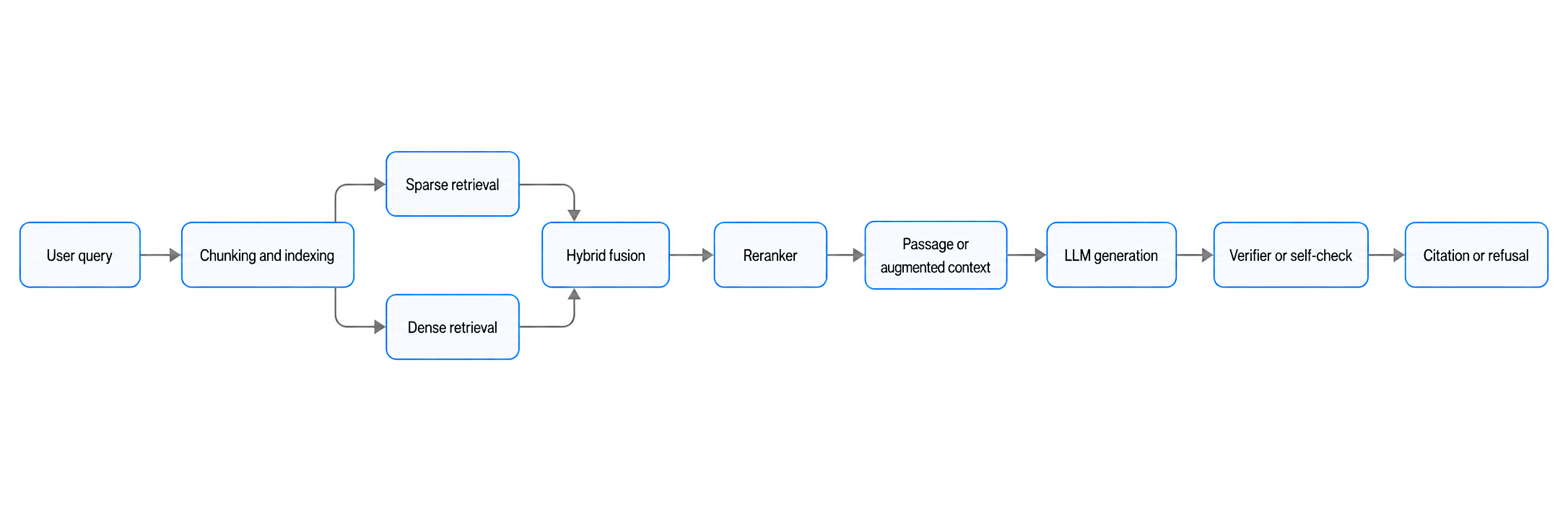
This workflow matches the public descriptions from RAG research, Anthropic’s contextual retrieval recommendations, and the current OpenAI and Anthropic tool ecosystems. RAG treats documents as latent evidence; Anthropic recommends embeddings plus BM25 plus reranking; OpenAI exposes vector stores, file search, retrieval, and web search with citation annotations. [14]
OpenAI’s current public docs show two distinct retrieval-facing products. Its Retrieval API is semantic search over vector stores: files are automatically chunked, embedded, and indexed; queries return chunks with similarity scores and metadata. Its File Search tool sits one level higher and lets the model search previously uploaded files via semantic and keyword search before generating. OpenAI’s Web Search tool is another hosted retrieval channel; the API returns a search-call record plus output text with annotations and inline URL citations, and OpenAI’s docs explicitly require these citations to remain visible to end users. [15]
Anthropic’s public tooling is similar in spirit but described a bit differently. Its tool-use docs distinguish client tools where Claude emits tool_use blocks and the application executes them from server tools such as web search or code execution that run on Anthropic’s infrastructure. Anthropic’s citations docs add a very explicit provenance layer: documents must opt into citations, Claude cites chunked spans or page ranges, and the platform guarantees citation pointers that are valid references into the provided documents. That is a practical grounding mechanism, not just a prompt trick. [16]
Anthropic has also publicly proposed a concrete hybrid retrieval recipe under the name Contextual Retrieval. The method prepends chunk-specific context before embedding and before BM25 indexing, then optionally reranks the retrieved set. In Anthropic’s reported experiments, contextual embeddings lowered top-20 retrieval failure rates, combining contextual embeddings with contextual BM25 lowered them further, and adding reranking reduced them still more, albeit with a latency and cost tradeoff. That is exactly the sort of engineering compromise I should expect in production systems: better retrieval quality almost always costs additional compute somewhere in the pipeline. [9]
The more academic side of this picture explains why reasoning prompts and tool use help. Chain-of-thought prompting can improve complex reasoning by making intermediate steps explicit; ReAct interleaves reasoning with environment actions such as retrieval; Toolformer shows that language models can be trained to decide when and how to call APIs; and WebGPT shows a complete browser-assisted QA loop trained with human feedback and references. The common pattern is that raw next-token prediction is strengthened by structured intermediate computation, whether that computation is reasoning text, search actions, calculator calls, or browser navigation. [17]
Sparse retrieval uses exact terms and an inverted index. Its main strength is strong exact matching, especially for identifiers, while also offering low latency. Its main weakness is that it performs poorly on paraphrase and semantic mismatch. Sparse retrieval usually has the lowest query cost, making it a strong fit for logs, codebases, regulations, and IDs.
Dense retrieval uses embeddings with ANN or MIPS search. Its main strength is strong semantic matching, which makes it useful when queries and documents express the same idea using different wording. Its main weakness is that it can miss literal strings and rare identifiers. Dense retrieval typically has moderate indexing and query cost, and it is best suited for semantic search and question answering over prose.
Hybrid retrieval combines sparse and dense retrieval through fusion. Its main strength is better recall and robustness, because it can benefit from both exact lexical matching and semantic similarity. Its main weakness is greater engineering complexity. The cost profile is higher than using a single retriever, but it is well suited for production RAG systems with mixed query types.
Reranking uses a cross-encoder or late-interaction model over the top-k retrieved candidates. Its main strength is achieving the best precision within the candidate list. Its main weakness is the extra latency and compute it introduces. Reranking has a higher per-query cost on a short candidate list, and it is best suited for high-stakes answers and search-quality improvements.
External memory uses retrieved documents or kNN memory. Its main strength is enabling updateable knowledge without retraining the whole model. Its main weakness is that it depends heavily on the quality of the memory and retrieval process. Its cost profile includes indexing and retrieval overhead, making it a good fit for rapidly changing knowledge.
Fine-tuning uses weight updates. Its main strength is persistent behavior and domain adaptation. Its main weakness is that it can be slow and costly, and it may overfit or go stale. Fine-tuning mainly involves offline training cost and is best suited for stable domains, tone adaptation, and policy adaptation.
Fine-tuning
Weight updates
Persistent behavior and domain adaptation
Slow, costly, can overfit or go stale
Offline training cost
Stable domains, tone/policy adaptation
This comparison is a synthesis of DPR and RAG for dense retrieval, BEIR for broad zero-shot tradeoffs, ColBERT and PLAID for late interaction and latency, Anthropic’s contextual retrieval for hybrid-plus-reranking behavior, OpenAI’s retrieval docs for vector-store pipelines, and Memorizing Transformers / post-training papers for the distinction between external memory and weight updates. [18]
The training story has several stages, and they matter because each stage updates a different part of the system. In OpenAI’s public GPT-4 report, GPT-4 is described as a Transformer-style model pre-trained to predict the next token and then fine-tuned using RLHF. InstructGPT gives the clearest public OpenAI recipe: supervised fine-tuning on demonstrations, reward-model learning from ranked outputs, and reinforcement learning from human feedback. Anthropic’s Constitutional AI describes a closely related two-stage post-training flow, but uses a constitutional rule set and AI feedback in addition to or instead of ordinary human preference labels. [19]
So if I separate the system by time, I get this:
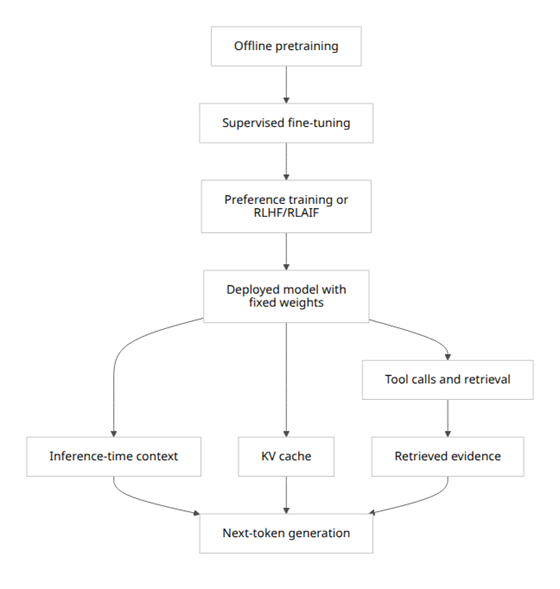
he crucial line is between offline weight updates and inference-time conditioning. Public OpenAI and Anthropic materials describe training and post-training separately from retrieval, tools, citations, and memory. GPT-4’s report states plainly that the deployed model “does not learn from experience,” which means a normal interaction does not permanently update the model weights. [20]
This is where many discussions get confused. In-context learning can look like real-time learning because the model improves its answer after seeing examples in the prompt. But theory papers show that this is better understood as the transformer implementing a learning-like algorithm inside its forward pass, using activations and context tokens, not by changing the persistent parameters show transformers can implement gradient-descent-like or ridge-regression-like updates in context for linear problems, and related work shows similar behavior for in-context reinforcement learning. That is genuine adaptation during inference, but it is still activation-space adaptation, not persistent weight learning. [21]
The distinction becomes clearer if I separate KV cache, retrieval, and external memory. The KV cache stores keys and values for previously processed tokens so later decoding steps can attend back without recomputing everything; it is temporary, request-local state. PagedAttention exists precisely because this cache becomes huge in real serving systems and can dominate memory usage. By contrast, retrieval adds externally stored evidence documents, files, web pages, vector-store chunks to the current prompt or structured context. And external memory architectures such as Memorizing Transformers go one step further by designing a writeable or searchable memory subsystem that is distinct from the model weights. These are three different mechanisms, and only the last two can make newly acquired information available beyond the bare current token stream. [22]
Mathematically, standard inference is still y = f_θ(x, "context", "tool outputs", "cache")
with fixed during a single session. If does not update, then the model has not learned a new permanent parameterization only conditioned on more information. This is exactly why RAG is so attractive: it gives the system access to fresh or proprietary information without retraining the entire model. The original RAG paper makes this motivation explicit and even notes that replacing the non-parametric memory can update the model’s world knowledge as the world changes. [23]
Can on-the-fly learning happen at all under current architectures? Yes, but only if I add an explicit mechanism: fine-tuning, online optimization, writeable external memory, or a retrieval/indexing system that changes what evidence is available at inference. Memorizing Transformers make this point very directly: language models usually need training or fine-tuning to acquire new knowledge, so the paper augments them with approximate kNN memory to let them read and make use of newly seen content at test time. In other words, on-the-fly learning is possible as system design, but not as a hidden magic property of ordinary frozen-weight inference. [24]
Once a model has retrieved evidence, the next question is whether the answer is actually well-supported. A strong validation pipeline usually has several layers: retrieve candidate evidence, generate an answer, attach provenance, estimate uncertainty, optionally verify atomic claims, and sometimes escalate to human review. WebGPT is the clearest public OpenAI-style example: it trains a model to browse the web, gather references, and answer with supporting evidence so that humans can more easily judge factual accuracy. DeepMind’s GopherCite pushes further toward quoted support, attempting to back factual claims with web evidence and to abstain with “I don’t know” when support is weak. [25]
A more formal verification view decomposes an answer into smaller claims. FACTSCORE does exactly this for long-form generations: it breaks an answer into atomic facts and asks what fraction are supported by a reliable knowledge source. That is a very useful way to think about validation mathematically, because it avoids treating a long answer as simply “true” or “false.” Google’s Attributed QA work makes a complementary point: the ability of a model to attribute generated text to evidence is a central benchmarkable capability in its own right. [26]
Calibration is the bridge between answer generation and safety policy. If a model’s confidence scores are unreliable, then “I’m 95% sure” is not operationally meaningful. Guo et al. showed modern neural nets are often overconfident, and proposed temperature scaling as a simple but effective post-hoc correction. Anthropic’s P(True) and P(IK) work is important here because it moves calibration from ordinary classification to language-model self-evaluation: the model first proposes an answer and then estimates the probability that the answer is true or that it actually knows the answer. MIT’s selective-QA work shows the next engineering step: use uncertainty not merely for display, but for abstention. [27]
In practical systems, provenance is now increasingly first-class. Anthropic’s citations API does not merely ask the model to mention a source in plain text; it returns structured citation pointers to page ranges or character spans in the provided documents. OpenAI’s web-search tool similarly returns cited URLs through structured annotations and requires visible inline citations in end-user interfaces. These are important advances because they make support inspectable. But they are still provenance signals, not mathematical proofs. A citation tells me what evidence the system used; it does not by itself guarantee that the evidence is sufficient, representative, or correct. [28]
That limitation is not hypothetical. WebGPT explicitly notes that references are helpful for evaluation but “far from a panacea,” because the model can learn to cherry-pick sources that seem persuasive. DeepMind makes the same point even more bluntly in GopherCite: evidence citation is only one part of trustworthiness, and some claims require multiple pieces of evidence plus a logical argument, because not all claims supported by some quote are actually true. So multi-source verification and human oversight remain important, especially in high-stakes settings. [29]
Human-in-the-loop approaches therefore remain foundational. InstructGPT uses human demonstrations and ranked preferences; Constitutional AI uses a constitution plus critique-and-revision and preference learning from AI feedback; WebGPT and GopherCite use human preference judgments about evidence-supported answers. The most reliable public systems are therefore not “purely autonomous truth machines.” They are hybrid sociotechnical systems that mix retrieval, scoring, citations, abstention policies, and human oversight. [30]
The most common failure mode is still hallucination: the model produces fluent but unsupported text. RAG helps because it can move part of the burden from parametric memory to retrievable evidence, but the original RAG paper itself motivates the method by noting that parametric models cannot easily revise memory, cannot straightforwardly provide insight into predictions, and may hallucinate. Retrieval therefore reduces one class of failure while adding another: if retrieval is wrong, incomplete, stale, or adversarial, the generation stage inherits those defects. [6]
A second failure mode is distribution shift. BEIR shows that retrieval systems behave differently when moved across domains and tasks; in zero-shot conditions, BM25 remains a strong robust baseline, while reranking and late interaction often win on average at higher cost. This matters because a dense retriever tuned on one domain can silently degrade on another, which is one reason hybrid search is so popular in practice. The same point appears in Anthropic’s contextual retrieval work: embeddings alone are not enough, and exact-match recovery still matters. [31]
A third failure mode is long-context degradation. Large marketed context windows do not mean uniform use of all tokens. Stanford’s “Lost in the Middle” paper shows that performance can drop significantly when relevant information is placed in the middle of long contexts, producing the now-famous U-shaped primacy/recency pattern. The paper also finds that adding more retrieved documents eventually runs into saturation: model performance can plateau before retriever recall does. So accuracy is not a monotonic function of context length; after some point, more context can add distraction faster than it adds usable signal. [32]
A fourth failure mode is misleading or adversarial evidence. DeepMind reports that GopherCite often stumbles on adversarial questions that exploit common internet misconceptions. That is a powerful caution: even if the model cites evidence, the internet can contain bad but highly retrievable evidence, and a model can be lured into surfacing it. So grounded generation reduces unsupported fabrication, but it does not eliminate epistemic attack surfaces. [33]
On the scaling side, public results are more nuanced than “bigger is always better.” OpenAI’s scaling-laws paper shows predictable power-law improvements with model size, data size, and training compute, and GPT-4’s report says OpenAI successfully extrapolated final loss and some capability metrics from much smaller runs. But DeepMind’s Chinchilla result shows that large models can be undertrained if data scaling lags behind parameter scaling; compute-optimal training roughly doubles tokens when model size doubles. So larger training sets, larger parameter counts, and better accuracy are linked, but only through a co-scaling law, not through any single knob. [34]
There are also real mathematical limits. Self-attention has a proven quadratic-time barrier in broad settings unless a major complexity assumption fails, according to Keles, Wijewardena, and Hegde. FlashAttention improves speed and memory traffic but does so by being an exact IO-aware implementation of attention rather than disproving quadratic structure. On the statistical side, calibration cannot be perfectly known from finite samples, and modern networks are often miscalibrated; on the learning-theory side, no-free-lunch results say there is no learner that is uniformly best across all possible problem distributions without assumptions or inductive bias. [35]
For a fixed task distribution, there is also an irreducible ceiling set by the true conditional uncertainty in the data. Guo et al. write calibration in terms of the true conditional distribution , and show that perfect calibration is impossible to verify exactly with finite samples. In that sense, the theoretical target is not “zero error no matter what,” but recovery of the best possible conditional predictor for the task distribution, subject to noise, model class, and finite data. In plain terms: some errors are architectural, some are optimization failures, some are retrieval failures, and some are simply irreducible uncertainty in the problem itself. [36]
What is not publicly established is just as important. OpenAI’s GPT-4 report explicitly withholds further architecture and training details, and the public materials from Anthropic that are readily available describe tools, citations, and post-training strategies more than they disclose internal production retrieval stacks or calibration layers. So any claim that “OpenAI definitely uses exactly X hidden fusion layer in production” or “Anthropic definitely verifies with Y proprietary ranker” would go beyond verified public evidence. Those details are unspecified in the official sources I reviewed. [37]
If I explain this to myself in the simplest accurate way, it is this: a current LLM like ChatGPT or Claude does not usually become permanently smarter in the moment just because it searched the web or read a file. Instead, it temporarily brings outside information into the conversation, weighs that information with imperfect search and ranking systems, and then generates the next words from a frozen model conditioned on that evidence. If I want permanent change, I need a separate update mechanism such as fine-tuning or an external memory that persists beyond the session. [38]
So the realistic picture is neither mystical nor pessimistic. Better systems can absolutely be built by improving retrieval, reranking, citations, calibration, uncertainty estimation, abstention, and human review. Public work from OpenAI, Anthropic, DeepMind, Stanford, MIT, and others shows steady progress on all of those fronts. But the progress is not free and not limitless in any simple sense: more context can hurt, more parameters without enough data can waste compute, search can retrieve bad evidence, and some resource and complexity barriers are mathematically real. [39]
My evidence-based answer to the final underlying question is therefore: AI enhancement is not proven to end soon, but it is also not proven to be unlimited. The verified literature supports continued improvement under better data, better training, better retrieval, and better system design, while also showing diminishing returns, hard engineering tradeoffs, and some formal limits for specific architectures. The frontier is still open, but it is not unconstrained. [40]
#AI #RAG #LLM
[1] [6] [7] [14] [23] Retrieval-Augmented Generation for Knowledge-Intensive NLP Tasks
https://arxiv.org/abs/2005.11401
[2] [8] [9] [39] Contextual Retrieval in AI Systems \ Anthropic
https://www.anthropic.com/research/contextual-retrieval
[3] [11] [27] [36] On Calibration of Modern Neural Networks
https://arxiv.org/abs/1706.04599
[4] [19] [20] [37] [38] cdn.openai.com
https://cdn.openai.com/papers/gpt-4.pdf
https://cs.stanford.edu/~nfliu/papers/lost-in-the-middle.arxiv2023.pdf
[10] ColBERT: Efficient and Effective Passage Search via Contextualized Late Interaction over BERT
https://arxiv.org/abs/2004.12832
[12] Uncertainty-aware Language Modeling for Selective Question Answering
https://arxiv.org/abs/2311.15451
[13] Building Effective AI Agents \ Anthropic
https://www.anthropic.com/engineering/building-effective-agents
[15] Retrieval | OpenAI API
https://platform.openai.com/docs/guides/retrieval
[16] Tool use with Claude - Claude API Docs
https://docs.anthropic.com/en/docs/agents-and-tools/tool-use/overview
[17] Chain-of-Thought Prompting Elicits Reasoning in Large Language Models
https://arxiv.org/abs/2201.11903
[18] Dense Passage Retrieval for Open-Domain Question Answering
https://arxiv.org/abs/2004.04906
[21] What learning algorithm is in-context learning? Investigations with linear models
https://arxiv.org/abs/2211.15661
[22] Efficient Memory Management for Large Language Model Serving with PagedAttention
https://arxiv.org/abs/2309.06180
[24] Memorizing Transformers
https://arxiv.org/abs/2203.08913
[25] WebGPT: Browser-assisted question-answering with human feedback
https://arxiv.org/abs/2112.09332
[26] FActScore: Fine-grained Atomic Evaluation of Factual Precision in Long Form Text Generation
https://arxiv.org/abs/2305.14251
[28] Citations - Claude API Docs
https://docs.anthropic.com/en/docs/build-with-claude/citations
[29] WebGPT: Browser-assisted question-answering with human feedback
https://arxiv.org/abs/2112.09332
[30] [2203.02155] Training language models to follow instructions with human feedback
https://arxiv.org/abs/2203.02155
[31] BEIR: A Heterogenous Benchmark for Zero-shot Evaluation of Information Retrieval Models
https://arxiv.org/abs/2104.08663
[33] GopherCite: Teaching language models to support answers with verified quotes - Google DeepMind
[34] [40] Scaling Laws for Neural Language Models
https://arxiv.org/abs/2001.08361
[35] On The Computational Complexity of Self-Attention