Improving React UI Responsiveness with useDeferredValue
- Home
- Improving React UI Responsiveness with useDeferredValue

Performance problems in React applications are not always caused by bad code. Sometimes the issue is priority.
Imagine a search page.
A user types into an input. Every keystroke updates state. That state is passed to a large result list, a complex table, or an expensive chart. Technically, everything works. But the input starts to feel slow.
The problem is not the input itself.
The problem is that the input update and the expensive UI update are treated as part of the same urgent rendering work.
React’s useDeferredValue helps solve this problem.
useDeferredValue lets you create a deferred version of a value.

The original value updates immediately. The deferred value may lag behind while React prioritizes more urgent UI updates.
A common example is search:
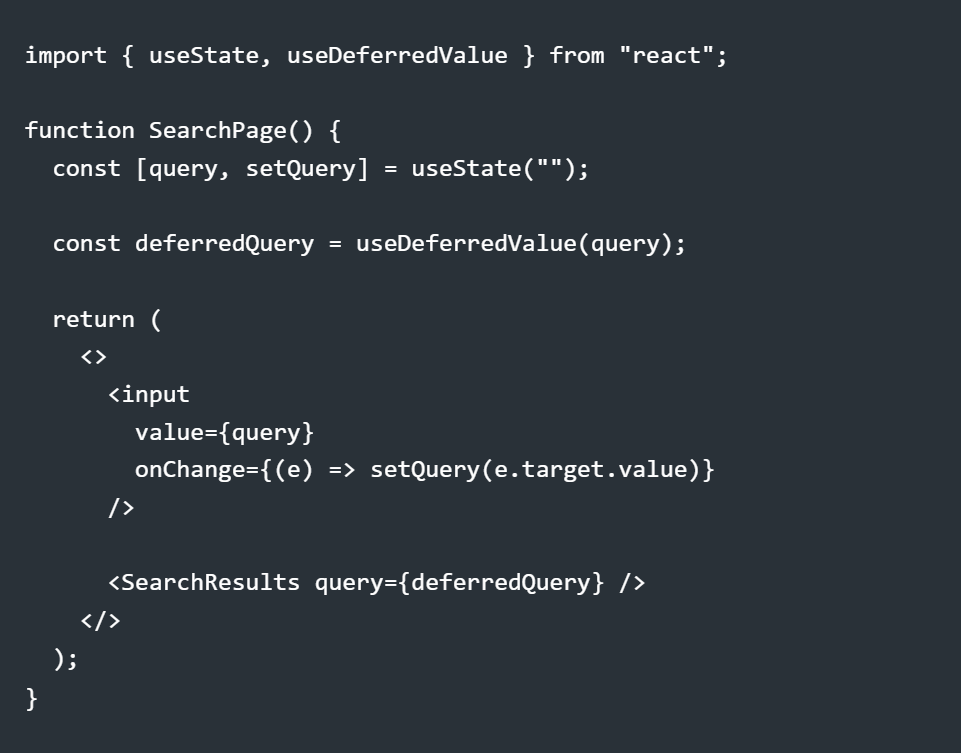
Here, the input is controlled by query, so it stays responsive.
The results are controlled by deferredQuery, so they can update slightly later if rendering them is expensive.
In many real applications, not every part of the UI has the same urgency.
Typing into an input should feel instant.
Updating a huge list can wait a little.
Rendering a heavy chart can wait a little.
Refreshing Suspense-driven content can wait until the new content is ready.
That is the main value of useDeferredValue: it helps React prioritize the interaction the user is directly performing.
This is an important distinction.
Debounce delays the work until the user stops typing for a certain amount of time.
useDeferredValue does not add a fixed delay. React starts working on the deferred update when it can. If a more urgent update happens, React can interrupt the background render and restart with the latest value.
So debounce is about timing.
useDeferredValue is about rendering priority.
One useful pattern is to make stale content visually clear:
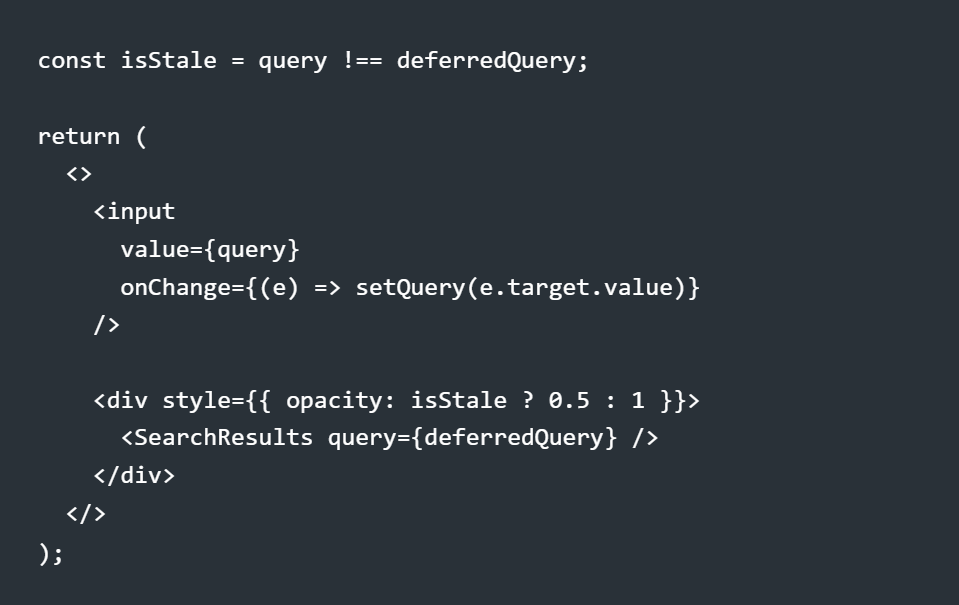
This tells the user: “You are seeing previous results while the new ones are being prepared.”
That small visual cue can make the experience feel much more intentional.
useDeferredValue is useful when:
The user interaction must stay fast. A child component is expensive to render. A list, chart, table, or result view can lag behind briefly. You want to avoid showing a loading fallback too aggressively. You want smoother perceived performance without changing your data model.
Do not use useDeferredValue as a replacement for fixing truly inefficient rendering.
Before reaching for it, still consider:
Memoizing expensive components. Virtualizing long lists. Avoiding unnecessary object creation during render. Splitting large components. Reducing expensive calculations.
useDeferredValue does not make slow rendering faster. It helps React schedule that slow rendering in a way that keeps the UI responsive.
React performance is not only about reducing work.
It is also about prioritizing work.
useDeferredValue is a great example of that mindset. It allows the most important part of the experience the user’s immediate interaction to stay smooth while less urgent UI catches up in the background.