Inside Microsoft SQL Server: Architecture, Storage Engine, Query Processing, and Enterprise Design
- Home
- Inside Microsoft SQL Server: Architecture, Storage Engine, Query Processing, and Enterprise Design

Microsoft SQL Server is more than a relational database management system. It is a sophisticated data-processing platform that integrates transactional storage, cost-based query optimization, concurrency control, memory management, recovery mechanisms, and enterprise operational capabilities.
Understanding SQL Server requires examining what happens beneath a SQL statement: how a query is compiled, how an index locates a record, how the buffer pool interacts with persistent storage, and how the transaction log guarantees durability without synchronously writing every modified data page.
This article examines SQL Server from the perspective of a database architect, focusing on three fundamental engineering concerns:
The final sections compare SQL Server 2025 with PostgreSQL 18 and MySQL 8.4 using the InnoDB storage engine.
SQL Server follows a layered architecture, although its internal components cooperate closely rather than operating as completely isolated services.
At its core are the relational engine, storage engine, and SQL Server Operating System (SQLOS).
Figure 1. SQL Server Database Engine: conceptual architecture
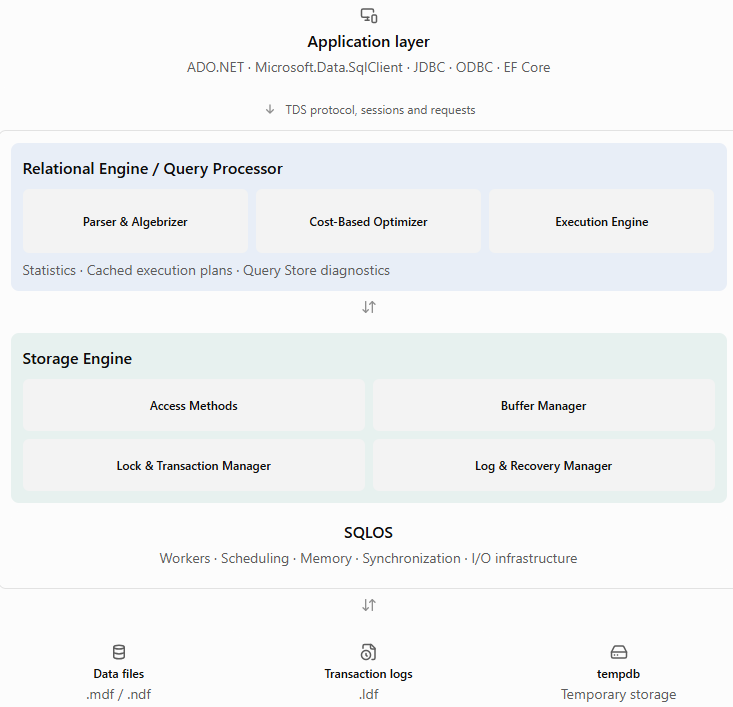
The relational engine is responsible for translating declarative SQL into an executable plan.
Consider:
SELECT CustomerId, SUM(Amount) AS TotalAmount FROM dbo.Payments WHERE Status = 'Completed' GROUP BY CustomerId;
The developer specifies the desired result, not the algorithm for obtaining it.
The engine must determine whether to scan an index, seek into a suitable range, use parallel operators, aggregate rows using hashing or sorting, and allocate execution memory.
Its major responsibilities are parsing and binding SQL, cost-based optimization, execution-plan generation, and execution orchestration.
The key architectural principle is that SQL expresses what data is required, while the optimizer selects how to obtain it.
The storage engine provides physical access to tables and indexes and coordinates persistent modifications.
It manages the buffer pool, accesses data pages, maintains index structures, generates transaction-log records, and participates in locking and recovery.
When a query requests a row, the execution engine works with storage access methods. If the required page is already cached, physical disk access may be unnecessary. Otherwise, the page must be read into memory.
This distinction between logical reads and physical reads is fundamental to SQL Server performance engineering.
SQLOS is SQL Server's internal resource-management infrastructure.
It manages workers, scheduling, memory-related services, synchronization, and I/O infrastructure. SQL Server can use multiple schedulers to coordinate work across available processing resources.
A session is not equivalent to a permanently dedicated operating-system thread. Requests are represented by tasks, which are executed by workers coordinated through SQL Server scheduling.
This matters under high concurrency. A request may experience latency because it is waiting for a worker, CPU time, a lock, execution memory, or physical I/O.
Adding CPU cores will not necessarily fix a workload dominated by blocking or transaction-log latency.
Microsoft documents these components in its Query Processing Architecture Guide and related engine documentation.
SQL Server separates logical organization from physical storage.
A SQL Server instance hosts system and user databases. Each database contains schemas, tables, indexes, views, procedures, functions, constraints, and metadata.
A schema provides a namespace and permissions boundary, not a separate physical data file.
SQL Server also includes the hidden, read-only Resource database containing system object definitions.
A database administrator must understand tempdb in particular because temporary storage can become a performance bottleneck even when application tables are correctly indexed.
SQL Server commonly uses:
SQL Server does not maintain all indexes in a separate index file. Rowstore indexes and tables are stored in data files, with their allocations managed internally.
Filegroups provide logical grouping and placement of data files. They can support partition placement, administrative operations, and selected backup and restore strategies.
For conventional disk-based SQL Server storage, the fundamental unit is an 8 KiB page.
Eight physically contiguous pages form a 64 KiB extent. SQL Server uses pages for table records, index structures, and internal allocation metadata.
Figure 2. Physical allocation hierarchy
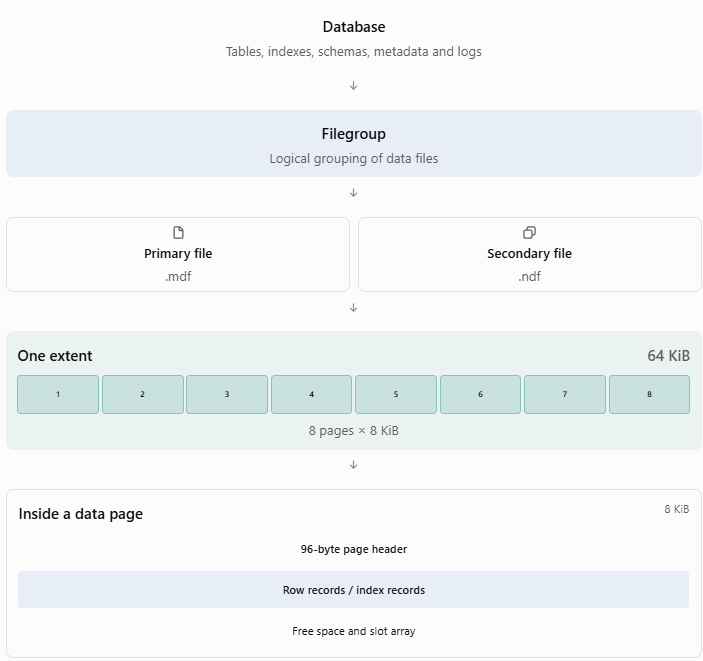
The page header contains information such as page identification, page type, and available space. The slot array provides access to records through offsets within the page.
A rowstore page does not necessarily contain complete values for every column. Large object values can be stored off-row, and variable-length data can use row-overflow allocations.
SQL Server also maintains allocation structures. The Page Free Space (PFS) pages help track page allocation and free-space information. Global Allocation Map (GAM) and Shared Global Allocation Map (SGAM) pages participate in extent allocation. Index Allocation Map (IAM) pages describe extents belonging to allocation units.
These structures are important when diagnosing allocation contention, especially in workloads that create and drop many temporary objects.
Index architecture is one of the most consequential physical design decisions in SQL Server.
A table can be stored as a heap, as a clustered rowstore index, or using a clustered columnstore organization. The following discussion focuses on rowstore.3.1 Heap tables
A heap is a table without a clustered index.
Rows are stored in data pages without a maintained clustering-key order. A heap can still have nonclustered indexes, with those indexes identifying rows through physical row identifiers (RIDs).
Heaps can be useful for certain staging and bulk-processing scenarios. They can also introduce complications such as forwarded records when variable-length updates cause rows to move.
They should be a deliberate architectural choice rather than the default for every transactional table.
A clustered rowstore index organizes data through a B+ tree.
The root and intermediate pages contain keys that direct navigation toward the appropriate leaf page.
The leaf level of a clustered index contains the actual table rows, rather than merely pointers to another copy of the table.
Figure 3. Clustered and nonclustered B+ tree lookup
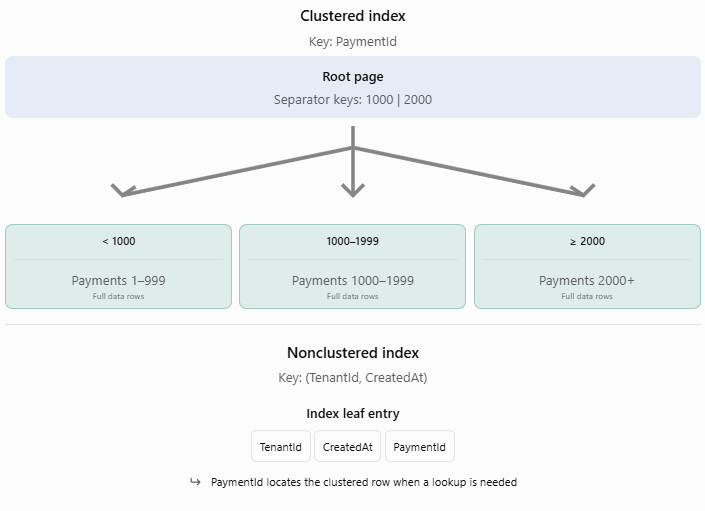
For a clustered table, nonclustered indexes use the clustering key as a row locator. On a heap, the locator is a RID.
A narrow clustering key is therefore valuable because its values can contribute to the storage requirements of nonclustered indexes.
A primary key and a clustered index are not synonymous. The primary key enforces logical uniqueness; the clustered index determines the rowstore organization. SQL Server commonly combines them by default, but they can be designed independently.
Consider a payment-processing system:
CREATE NONCLUSTERED INDEX IX_Payments_Pending ON dbo.Payments ( TenantId, CreatedAt ) INCLUDE ( Amount, CurrencyCode ) WHERE Status = 'Pending';
This index combines three techniques.
First, key columns support a suitable seek or range access path. Second, included columns make additional values available directly from index leaf pages. Third, the filter avoids storing rows whose status is not Pending.
A compatible query can then use the index:
SELECT PaymentId, CreatedAt, Amount, CurrencyCode FROM dbo.Payments WHERE TenantId = @TenantId AND Status = 'Pending' AND CreatedAt >= @FromUtc AND CreatedAt < @ToUtc;
Assuming PaymentId is the clustered key, it is also available through the nonclustered row locator. A suitable execution plan may avoid visiting the base table.
This is not guaranteed. Parameterization, predicate compatibility, statistics, and estimated cost determine whether the optimizer selects the index.
Every additional index also has a price: extra storage, maintenance during writes, and potentially greater logging activity.
Rowstore organization is effective for selective lookups and relatively small ranges. Columnstore organization stores values in a column-oriented compressed format, making it attractive for large scans and aggregations.
A clustered columnstore index can provide the principal storage for an analytical table. A nonclustered columnstore index can be added to a rowstore table when transactional and analytical access need to coexist.
Columnstore uses rowgroups, compressed column segments, and related metadata such as dictionaries and delete information. Batch-mode execution can process multiple rows at once rather than using conventional row-at-a-time operator processing.
These capabilities are especially useful for analytics, but create different write, maintenance, and storage considerations.
The relational engine converts a declarative SQL statement into a physical execution plan. Understanding this process is essential because two syntactically different statements can produce the same execution plan, while identical SQL statements can behave differently as data distribution or parameter values change.
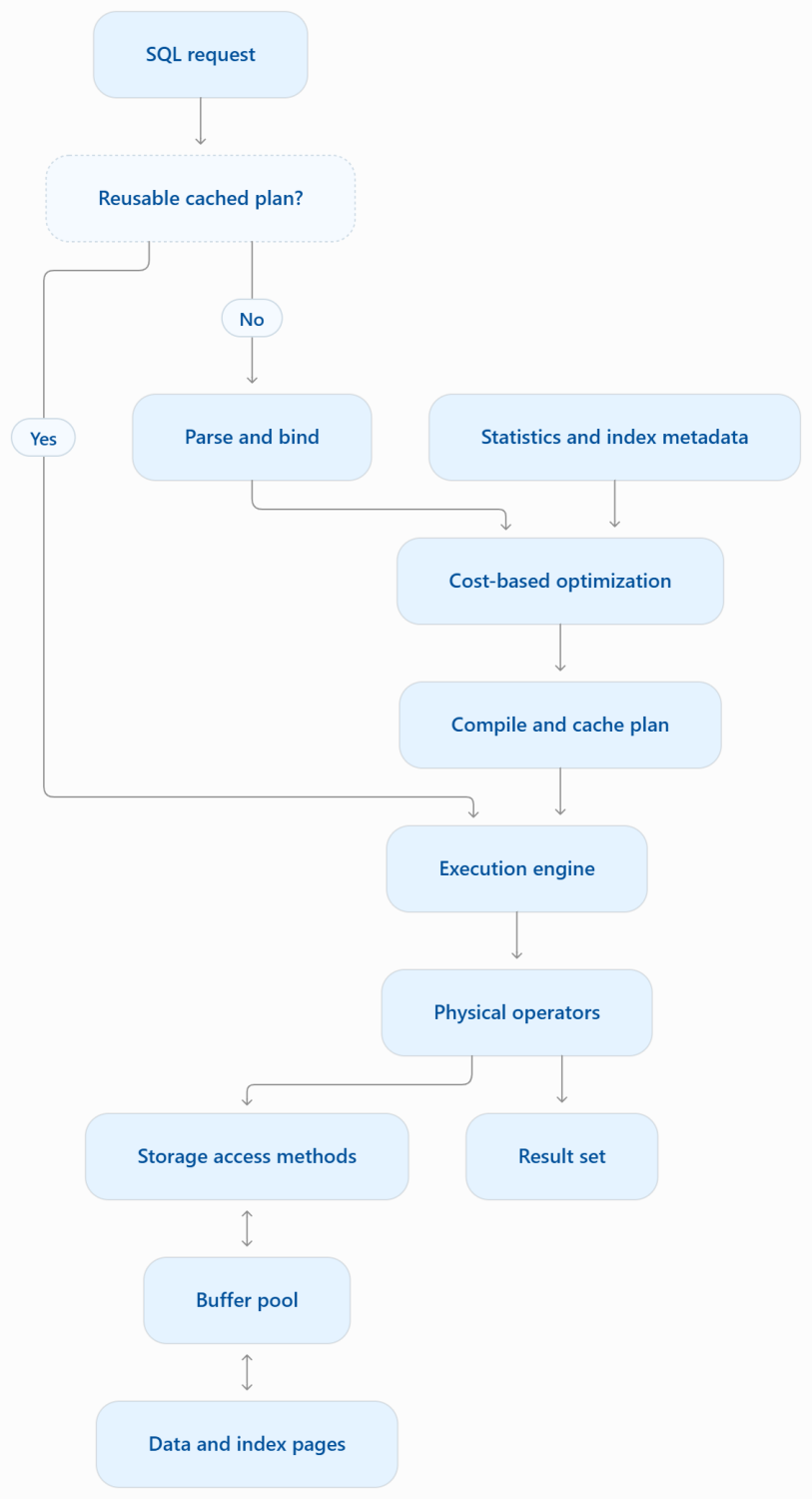
During parsing, the engine examines SQL syntax. Binding, traditionally called algebrization in SQL Server, resolves object and column references and validates their semantics.
The optimizer then considers alternative physical plans using statistics, available access paths, cardinality estimates, and cost models.
For example, a join may be executed using nested loops, hash join, or merge join. These algorithms have different resource profiles.
SQL Server Join Algorithms
1. Nested Loops Join: Executes matching operations repeatedly against an inner input. Effective for small outer inputs and efficient indexed lookups.
2. Hash Join: Constructs a hash structure for joining inputs. Useful for larger equality joins; can consume significant execution memory.
3. Merge Join: Processes inputs compatible with a common ordering. Efficient when suitable ordering exists without an expensive sort.
No algorithm is universally superior. An inappropriate cardinality estimate can make an otherwise reasonable algorithm perform poorly.
Consider a payments table containing 100 million records distributed across thousands of tenants.
One tenant might have 500 rows, while another has 15 million.
A query filtering by TenantId can benefit from very different execution strategies depending on which tenant is requested.
Statistics help estimate how much data a predicate will select. These estimates influence join order, index selection, parallelism, and memory grants.
The optimizer does not know the actual row count before execution. It estimates row counts from available information and chooses a plan accordingly.
SQL Server caches execution plans to avoid unnecessary compilation.
However, a plan compiled for a small tenant can perform poorly when reused for a very large tenant.
Modern SQL Server versions provide Parameter Sensitive Plan optimization, allowing eligible queries to use multiple plan variants associated with different parameter cardinalities.
SQL Server 2025 also supports Optional Parameter Plan Optimization for eligible optional-predicate patterns. Support varies by version, compatibility level, eligibility, and edition.
This is an important distinction: parameter sniffing is not inherently a defect. It becomes problematic when plan reuse does not match the characteristics of subsequent executions.
Query Store persists information about queries, execution plans, runtime statistics, and supported wait statistics.
It enables DBAs to examine how query performance changed over time, identify regressions associated with plan changes, and apply plan forcing when appropriate.
The plan cache alone cannot provide the same reliable historical perspective, because cached plans can be replaced or evicted.
Query Store is particularly valuable when a query suddenly becomes slow after an index change, statistics update, or deployment.
SQL Server uses memory for several purposes, including caching data pages, caching plans, compiling queries, and providing temporary execution memory.
The buffer pool holds cached data and index pages. A page that is present in the buffer pool can be accessed without requiring a new physical read.
However, not every query that completes from cached pages is inexpensive. Logical reads still require CPU and memory-bandwidth resources.
5.1 Memory grants
Operations such as hash joins, sorts, and some aggregation strategies may require execution memory grants.
If insufficient memory is granted, an operation may spill work to tempdb. If excessive memory is granted, the query may limit concurrency by reserving resources that other requests need.
This is why memory performance should be evaluated in the context of query plans and concurrent workloads, not merely total RAM utilization.
SQL Server Wait Types and Performance Investigation
SQL Server exposes extensive wait information that helps identify where requests spend time.
1. PAGEIOLATCH_*: Physical data-page I/O latency.
2. PAGELATCH_*: In-memory page structure contention.
3. WRITELOG: Transaction-log flush latency.
4. LCK_M_*: Transactional blocking.
5. RESOURCE_SEMAPHORE: Execution memory-grant pressure.
A latch is an internal synchronization mechanism protecting an in-memory structure, whereas a lock coordinates transactional access. High wait totals are not automatically evidence of a problem. They must be correlated with active requests, elapsed time, throughput, and resource metrics. For example, adding memory may help a workload dominated by physical reads, but it will not necessarily resolve a long-running transaction holding locks.
Durability in SQL Server relies heavily on its transaction log. The critical architectural principle is Write-Ahead Logging (WAL). Before a modified data page can be flushed to its data file, the corresponding transaction-log records must be durable.
Figure 5. Transaction commit and asynchronous data-page flushing
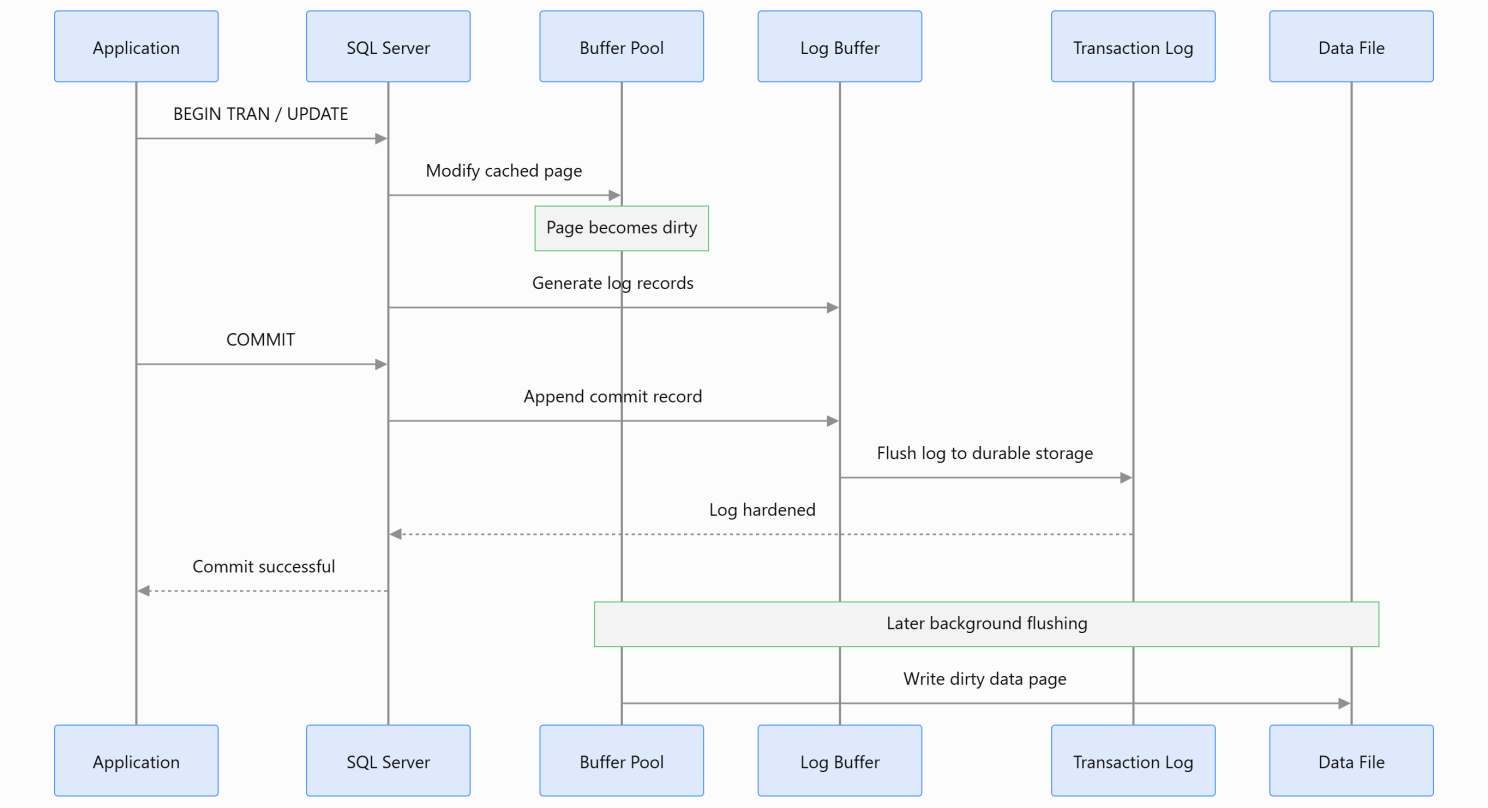
A transaction may modify many pages that are scattered throughout a database.
Synchronously writing every modified data page during commit would introduce substantial random I/O and increase transaction latency.
SQL Server instead records modifications in the sequential transaction-log stream.
When the commit record and preceding required log records have been hardened, a fully durable local transaction can be acknowledged. Modified data pages can be written later.
This is a fundamental separation between transaction durability and data-page persistence.
Microsoft Learn
Transaction-log records are ordered using Log Sequence Numbers (LSNs).
The physical log is divided into Virtual Log Files (VLFs). Their count and size influence aspects of log management and recovery.
The active portion of the log must retain records that are still required for recovery or other engine operations.
Long-running transactions can prevent log-space reuse. So can circumstances such as unprocessed log records needed by replication or availability technologies.
Transaction-log truncation makes reusable log space available internally. It does not automatically shrink the physical .ldf file.
SQL Server Recovery Phases
Traditional SQL Server recovery conceptually involves three phases:
1. Analysis: Determines relevant transaction and recovery state.
2. Redo: Reapplies logged modifications when necessary.
3. Undo: Reverses effects of transactions that must not remain committed.
This approach ensures that the database can return to a transactionally consistent state after an unexpected interruption.
Accelerated Database Recovery (ADR) changes recovery and rollback behavior by using persistent row-version information and other mechanisms.
A key component is the Persistent Version Store (PVS), stored within the database. ADR helps avoid recovery and rollback times that would otherwise grow substantially because of long-running transactions.
SQL Server 2025 additionally supports enabling ADR in tempdb.
ADR introduces its own version-storage and cleanup overhead. Large write-intensive workloads still require monitoring and capacity planning.
Concurrency control is where database architecture becomes directly visible to application developers.
SQL Server supports traditional locking and row-version-based approaches.
Its conventional READ COMMITTED isolation behavior uses locking when Read Committed Snapshot Isolation (RCSI) is disabled.
With RCSI enabled, ordinary read-committed statements can obtain a consistent committed snapshot instead of relying on shared data locks for their reads.
SQL Server also provides transaction-level SNAPSHOT isolation.
7.1 Locking versus row versioning
Figure 6. Simplified reader/writer interaction
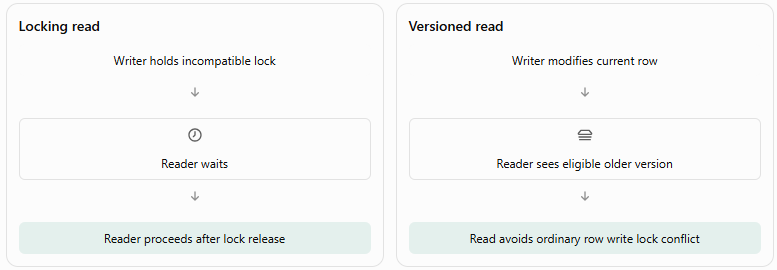
7.2 Isolation tradeoffs
SQL Server Transaction Isolation Levels
1. Read Uncommitted: Allows dirty reads.
2. Read Committed: Prevents dirty reads; locking or versioning behavior depends on configuration.
3. Repeatable Read: Protects previously read rows, but does not generally eliminate phantom scenarios.
4. Snapshot: Provides a transaction-consistent snapshot with update conflict considerations.
5. Serializable: Provides stronger guarantees, including protection against relevant phantom changes.
SQL Server's SNAPSHOT isolation is not automatically equivalent to full serializability.
The distinction is important in payment processing, inventory reservation, and financial-accounting operations, where application-level invariants matter. Database constraints, appropriate locking, and transaction boundaries remain necessary even when readers use versions.
1. Columnstore Indexes
Architectural Value: Column-oriented storage and batch-oriented analytics.
Tradeoff: Additional structures and write-maintenance overhead.
2. In-Memory OLTP
Architectural Value: Specialized memory-optimized transaction processing.
Tradeoff: Schema, query, and feature limitations must be assessed.
3. System-Versioned Temporal Tables
Architectural Value: Automatic retention and querying of historical row states.
Tradeoff: Growing history storage and retention requirements.
4. Indexed Views
Architectural Value: Synchronously maintained precomputed view results.
Tradeoff: Additional work during modifications and strict eligibility rules.
5. Query Store
Architectural Value: Historical query diagnostics and plan control.
Tradeoff: Requires capture and retention management.
6. Always Encrypted
Architectural Value: Client-side protection of selected sensitive data with key separation.
Tradeoff: Driver, query, and key-management constraints.
7. Change Data Capture (CDC)
Architectural Value: Captures qualifying table changes for downstream consumers.
Tradeoff: Log processing, retention, and operational dependencies.
Temporal tables are useful when an application must reconstruct how its recorded data changed over time.
A payment-status table, for example, may need to answer:
What payment status was recorded at 10:30 UTC on a particular date?
With system versioning enabled, SQL Server maintains historical row versions and supports time-oriented queries through FOR SYSTEM_TIME.
This reduces the need to implement routine history-table maintenance through application code or triggers, but it is not a substitute for a comprehensive security audit or immutable event log.
SQL Server indexed views persist and synchronously maintain eligible query results. In PostgreSQL, built-in materialized views use an explicit refresh mechanism to replace their stored results.
These designs have different consistency and workload implications. SQL Server's indexed view can make precomputed results available immediately after base-table changes, but those changes must also maintain the indexed view. PostgreSQL's explicit refresh model allows work to be scheduled separately when some result staleness is acceptable.
SQL Server distinguishes high availability, read scaling, and disaster recovery. An Always On Availability Group maintains database replicas across SQL Server instances.
For a particular availability database, one replica acts as the writable primary. Secondary replicas receive and harden transaction-log records, then redo changes to update their database copies.
Figure 7: Simplified Availability Group Topology
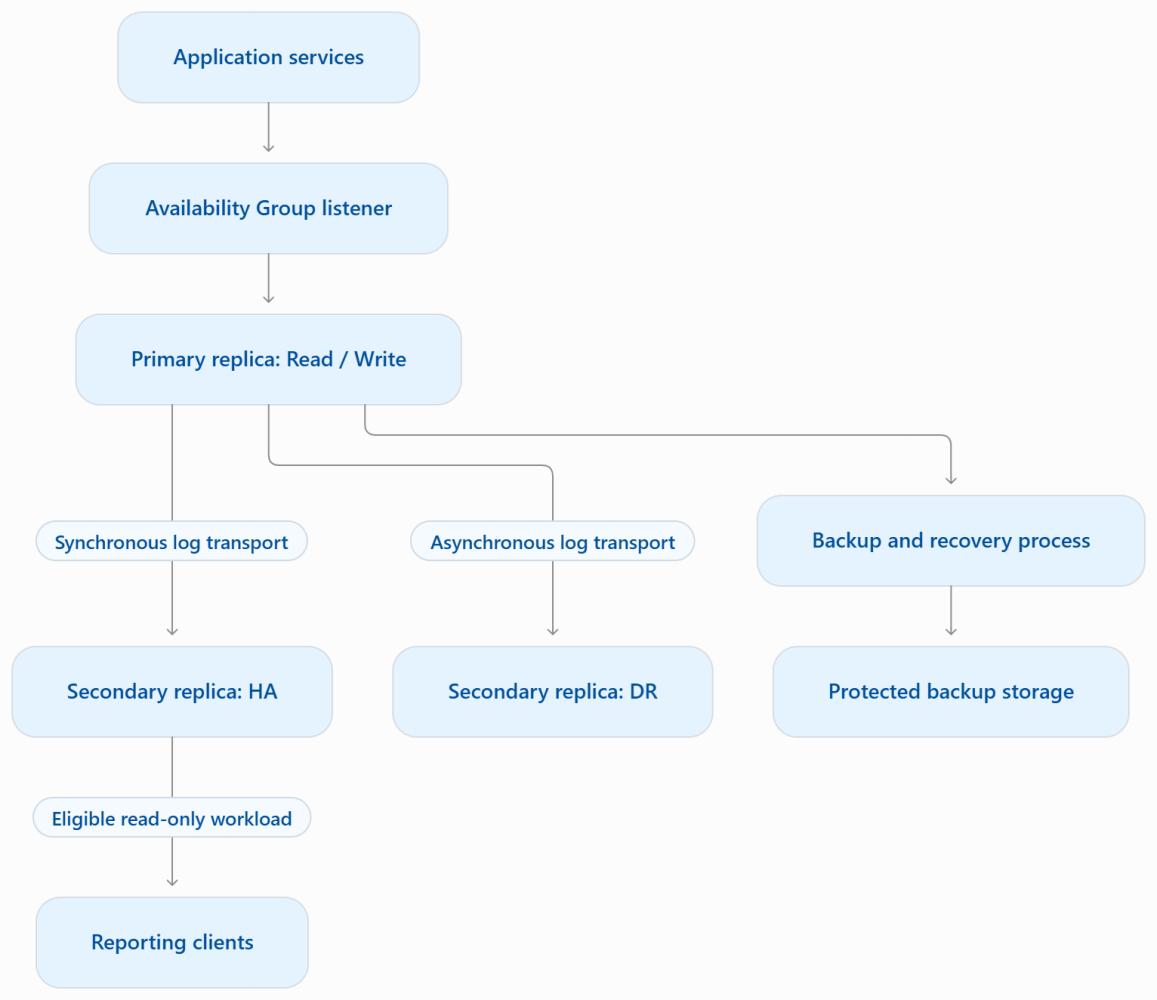
9.1 Synchronous and asynchronous commit
With synchronous commit, the primary waits for required log-hardening acknowledgement from a participating synchronous secondary before acknowledging the transaction.
With asynchronous commit, the primary can acknowledge transactions without waiting for the secondary.
The first approach emphasizes protection of committed data, with additional latency and availability considerations. The second can reduce cross-site commit dependencies but permits a data-loss window if the primary is lost before changes arrive remotely.
9.2 Failover Cluster Instances versus Availability Groups
A Failover Cluster Instance provides instance-level failover using a cluster and accessible database storage.
An Availability Group works at the database-replica level and maintains separate database copies.
They address related but different failure scenarios.
Neither eliminates the need for backups.
9.3 Recovery objectives
The architecture should explicitly define two measurable requirements:
Availability Groups can reduce interruption under suitable failure conditions, but accidental data deletion, corruption, and application errors may propagate to replicas.
Backups, tested restores, retention policies, and protection of encryption keys remain separate requirements.
A useful architectural comparison must distinguish engine capabilities from the extensions, managed services, or third-party products that can be added around them.
The following table compares SQL Server 2025, PostgreSQL 18's standard engine, and MySQL 8.4 using InnoDB. It does not imply that all SQL Server features are available in every edition.
SQL Server vs. PostgreSQL vs. MySQL/InnoDB: Architectural and Technical Comparison
1. Storage Architecture and Data Organization
SQL Server supports both heap-based storage and clustered B+ tree structures, providing flexibility in physical rowstore organization.
PostgreSQL follows a heap-based architecture, maintaining indexes separately from the underlying table storage.
MySQL/InnoDB uses clustered storage, typically organized around the primary key.
2. Concurrency Control and Row Versioning
SQL Server supports Multi-Version Concurrency Control (MVCC) through configurable row-versioning isolation mechanisms.
PostgreSQL incorporates MVCC as a fundamental component of its concurrency architecture.
MySQL/InnoDB implements MVCC using undo information to manage row versions.
3. Indexing Capabilities and Analytical Processing
SQL Server provides filtered indexes, covering indexes, columnstore indexes, and additional specialized indexing options. Native columnstore support enables column-oriented analytical processing.
PostgreSQL offers extensive indexing capabilities, including partial indexes, covering indexes, GIN, GiST, and BRIN. Columnstore analytics are not native to its standard heap engine.
MySQL/InnoDB supports clustered, secondary, composite, and functional indexes. Native columnstore analytics are not available in ordinary InnoDB, although a separate HeatWave architecture exists.
4. Query Performance Diagnostics and Execution Plan Management
SQL Server provides an integrated Query Store for historical query diagnostics and execution plan management.
PostgreSQL relies on statistics, execution plan analysis tools, and additional tooling to support comparable diagnostic workflows.
MySQL/InnoDB provides Performance Schema and related tools for performance monitoring and diagnostics.
5. Temporal Data Management and Historical Records
SQL Server natively supports system-versioned temporal tables, enabling automatic maintenance of historical row states.
PostgreSQL requires additional implementation to achieve equivalent automatic historical tracking.
MySQL/InnoDB similarly requires additional implementation for temporal row-history management.
6. Materialized Data and Precomputed Results
SQL Server supports indexed views, maintaining precomputed results synchronously as underlying data changes.
PostgreSQL provides materialized views that require explicit refresh operations.
MySQL/InnoDB does not provide an equivalent native materialized-view feature in ordinary MySQL 8.4.
7. High Availability and Replication Architecture
SQL Server offers Availability Groups, clustering, and multiple replication options.
PostgreSQL supports streaming replication, logical replication, and complementary high-availability tooling.
MySQL/InnoDB provides replication, Group Replication, and InnoDB Cluster capabilities.
8. Extensibility and Platform Integration
SQL Server provides strong integration with the Microsoft technology ecosystem.
PostgreSQL distinguishes itself through a particularly extensive extension ecosystem.
MySQL/InnoDB offers a plugin architecture supported by open-source and commercial solutions.
9. Licensing and Commercial Considerations
SQL Server follows a commercial licensing model with differences between editions.
PostgreSQL is distributed under a permissive open-source license.
MySQL offers a GPL-licensed Community Edition alongside commercial offerings.
PostgreSQL uses heap storage with separate secondary indexes, although eligible index-only scans can avoid heap access when visibility information permits. InnoDB, by contrast, already stores its rows in a clustered index.
10.1 Where SQL Server has meaningful advantages
Integrated performance diagnostics. Query Store connects historical plans, runtime information, and plan-management mechanisms. This can reduce the effort required to diagnose regressions compared with assembling an equivalent workflow from several tools.
Mixed transactional and analytical workloads. Native columnstore indexing provides a mature option for combining operational data with analytical access. Its advantages depend on data volume, query shape, and modification rates.
Historical application data. Native temporal tables can simplify systems where the application frequently needs previous recorded row states.
Specialized data protection. Always Encrypted, TDE, auditing, and related controls provide useful choices within the Microsoft ecosystem. Comparable protection may be achievable elsewhere, but the mechanisms and integrations differ.
Enterprise operational consistency. SQL Server tooling, diagnostics, backup facilities, and availability technologies can be attractive for teams already standardized on Microsoft infrastructure.
These are meaningful advantages, not proof of universally higher throughput.
10.2 Where PostgreSQL may be architecturally preferable
PostgreSQL has a strong extension ecosystem, flexible indexing methods, and sophisticated JSON and spatial capabilities.
GIN indexes are useful for certain composite data types and search patterns, while BRIN indexes offer compact indexing for suitably correlated large datasets.
PostGIS is also a significant advantage for complex geospatial workloads.
Its default concurrency architecture uses MVCC, and its permissive license can substantially influence total cost and deployment flexibility.
PostgreSQL requires normal MVCC maintenance through vacuuming. Autovacuum and transaction-ID management are important operational concerns, not reasons to consider the engine inherently unsuitable for large systems.
10.3 Where MySQL may be architecturally preferable
MySQL can be a strong choice for applications that already depend on its ecosystem, compatibility characteristics, and established operational practices.
InnoDB provides clustered storage, MVCC, transactions, and recovery capabilities. Its default transaction isolation is Repeatable Read, unlike conventional SQL Server Read Committed defaults.
MySQL Community Edition also has replication and Group Replication capabilities.
A well-operated MySQL deployment can be preferable to a poorly designed SQL Server deployment, regardless of the latter's broader feature set.
10.4 What the comparison does not establish
There is no architecture-only basis for claiming that SQL Server always performs better than PostgreSQL or MySQL.
All three can process demanding transactional workloads. Performance depends on schema design, indexing, query optimization, concurrency, memory, storage latency, workload shape, configuration, and operational expertise.
SQL Server's advanced features also require edition-aware evaluation. For example, SQL Server 2025 distinguishes Enterprise and Standard availability and intelligent-query-processing features.
The following practices should form part of a production SQL Server engineering standard.
11.1 Diagnose before optimizing
A slow query is a symptom, not a root cause. Use measured evidence to determine whether the limiting factor is:
SQL Server Performance Troubleshooting: Symptom-Driven Diagnostics
Effective SQL Server performance troubleshooting begins with identifying the observed symptoms and examining the relevant execution, storage, and transaction-processing characteristics.
1. Query Execution and Resource Utilization
High Logical Reads: Investigate query structure, data selectivity, index design, and base-table lookups to identify the sources of excessive logical reads.
High Physical I/O: Examine buffer effectiveness, storage latency, and working-set size to understand physical I/O overhead.
High CPU Utilization: Analyze execution plans, cardinality estimates, repeated query execution, and computationally expensive expressions.
Sort and Hash Spills: Evaluate cardinality estimates, memory grants, and execution operators associated with sort and hash operations.
2. Transaction Processing and Concurrency
Significant Blocking: Investigate transaction duration, locking behavior, data access order, and transaction isolation.
High Transaction Log Latency: Examine transaction throughput, log storage performance, commit behavior, and availability replicas.
3. Performance Regression and Execution Plan Stability
Performance Regression After Deployment: Use Query Store to investigate execution plan changes, statistics, schema modifications, and parameter distribution.
11.2 Measure query execution
The following commands can be useful in a controlled diagnostic session:
SET STATISTICS IO ON; SET STATISTICS TIME ON; SELECT CustomerId, SUM(Amount) AS TotalAmount FROM dbo.Payments WHERE Status = 'Completed' GROUP BY CustomerId; SET STATISTICS TIME OFF; SET STATISTICS IO OFF;
STATISTICS IO reports logical and physical I/O-related information for the statement. STATISTICS TIME reports CPU and elapsed execution timing.
Combine this information with an actual execution plan, repeated measurements, realistic parameters, and representative concurrency.
One fast execution in a test environment does not prove good production performance.
11.3 Design from workload characteristics
11.4 Protect concurrency
11.5 Configure memory and storage intentionally
11.6 Maintain evidence-based statistics and indexes
11.7 Build for recoverability
A production-ready deployment needs a documented and tested recovery process. That process should include backup validation, integrity checks, restore rehearsals, availability failover testing, monitoring, and explicit recovery objectives. The ability to initiate a restore is not the same as the ability to meet an agreed RTO. Security should follow least privilege, with separated operational identities, appropriate encryption, protected secrets, and controlled network access.
For enterprise solution design, the database decision should begin with workload classification.
Database Platform Selection: Workload-Driven Architectural Decision Framework
Choosing between SQL Server, PostgreSQL, and MySQL requires aligning database capabilities with workload characteristics, infrastructure maturity, and architectural requirements.
1. Enterprise OLTP and Transactional Integrity
For high-integrity OLTP workloads operating within an established Microsoft infrastructure, SQL Server represents a strong architectural candidate. The evaluation should prioritize transaction latency, isolation requirements, and licensing considerations.
2. Hybrid Transactional and Analytical Workloads
For transactional systems with significant analytical reporting requirements, assess SQL Server's combined rowstore and columnstore capabilities against the alternative of deploying a separate analytical system.
The architectural decision should reflect the workload's transactional and analytical requirements.
3. Extensibility, JSON Processing, and Geospatial Workloads
For applications with extensive extension requirements, JSON-centric data models, or advanced geospatial processing, PostgreSQL deserves particular architectural consideration.
4. Established MySQL Ecosystems
For applications already operating within a mature MySQL ecosystem, retaining or selecting MySQL remains a valid architectural decision, provided its capabilities satisfy the application's functional and operational requirements.
5. Globally Distributed Write Operations
For systems requiring globally distributed writes, distributed-database requirements must be evaluated independently.
Conventional read-replica architectures are insufficient to address distributed write requirements.
6. Historical Data Management and Regulatory Compliance
For systems with strict historical data retention and compliance requirements, evaluate the following as distinct architectural capabilities:
Each capability should be assessed independently as part of the overall database architecture decision.
Microsoft SQL Server's architectural sophistication lies in the integration of several powerful subsystems: the relational optimizer, storage engine, SQLOS execution infrastructure, buffer management, write-ahead logging, row-versioning mechanisms, recovery processing, and enterprise operational tooling.
Its clustered indexing model offers precise control over physical row organization. Query Store and intelligent-query-processing capabilities help manage complex workloads. Columnstore expands the engine's analytical capabilities, while temporal tables, indexed views, memory-optimized processing, and availability technologies address specialized enterprise requirements.
PostgreSQL and MySQL offer different architectural strengths. PostgreSQL emphasizes extensibility, sophisticated indexing, MVCC, and open-source flexibility. MySQL offers a mature InnoDB transactional architecture and a broad operational ecosystem.
The architect's responsibility is not to select the database with the longest feature list. It is to choose the engine whose architecture, operational characteristics, consistency guarantees, and economic model best match the system's requirements.
A deep understanding of SQL Server internals makes that decision more rigorous. It also makes performance problems easier to diagnose and production systems easier to operate.
Technical / Solutions Architect
https://www.linkedin.com/pulse/inside-microsoft-sql-server-architecture-storage-engine-melkumyan-bninf/