Video Metadata Caching – The Vimeo Blueprint
- Home
- Video Metadata Caching – The Vimeo Blueprint

Infrastructure-managed stampede control, with freshness managed in the application keyspace
Design invariant. In Vimeo’s design, groupcache coordinates who fills the cache on a miss, but it does not provide native TTL-based freshness. Freshness is enforced by the application through time-windowed keys with deterministic jitter.
Before a single frame is streamed, Vimeo must resolve a large amount of video metadata: title, privacy settings, playback options, formats, and other control-plane attributes. At scale, the read pressure of this metadata path made the relational database tier increasingly expensive to scale.
A traditional Memcached deployment could absorb some of that read traffic, but it still left Vimeo exposed to the classic cache stampede. When a hot key missed, many concurrent requests could pile through and hammer the database at once.
Vimeo therefore optimized for two things at the same time: first, infrastructure-level coordination so that only one peer performs the fill for a given missing key; second, an application-managed freshness model that works even when the cache engine itself is intentionally simple and mostly immutable.
Vimeo moved metadata caching to groupcache, a Go library that handles peer-to-peer cache fills. Under load, that changes the miss path dramatically. Instead of every node independently hitting the database for the same missing item, the library routes ownership of the key to a single responsible peer. That peer performs one coordinated fill, and the result is multiplexed back to the waiting callers.
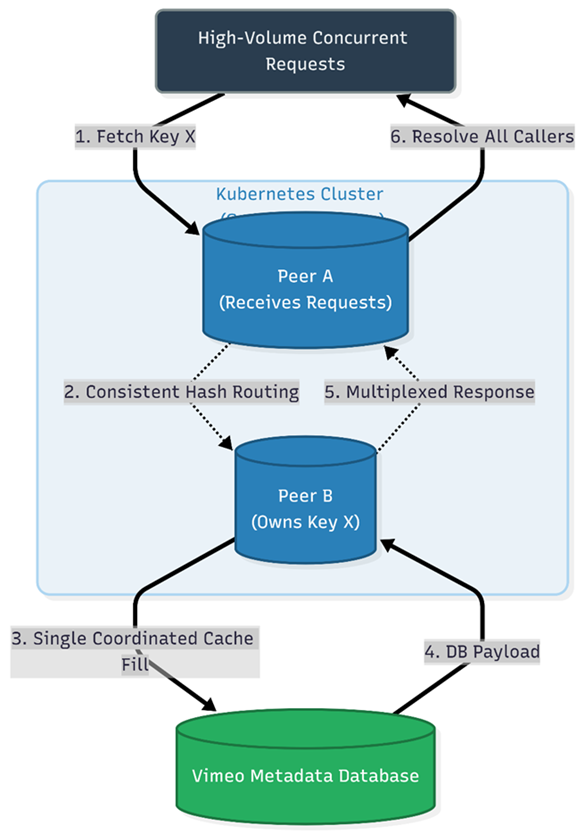
This is the central contrast with a naive look-aside cache. In a naive design, a hot miss can create a read storm. In Vimeo’s design, a hot miss becomes a single database read plus coordinated fan-out. That is an infrastructure-level answer to a concurrency problem.
Groupcache’s strength is coordination, not mutability. It does not behave like a normal cache with per-entry TTL that silently expires values in place. That meant Vimeo had to make a deliberate architectural choice: freshness would be controlled outside the cache engine.
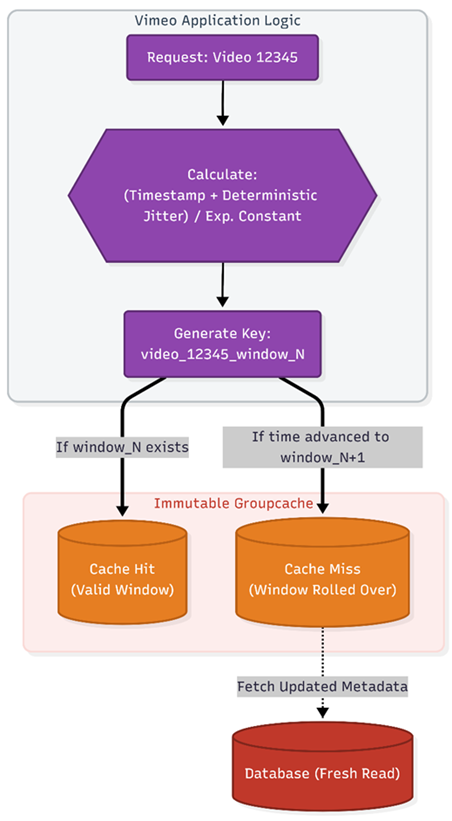
The workaround is elegant. The application does not cache a static key such as video_12345. Instead, it computes a time-windowed key such as video_12345_window_N. When wall-clock time advances into the next freshness window, the application generates a different key, which naturally causes a miss and forces a refresh from the database.
The crucial detail is jitter. If every key rolled over at the exact same second, the system would create a synchronized miss wave. Vimeo therefore injects deterministic jitter into the window calculation so that different objects roll at different times. The result is still application-controlled freshness, but without scheduled, system-wide stampedes.
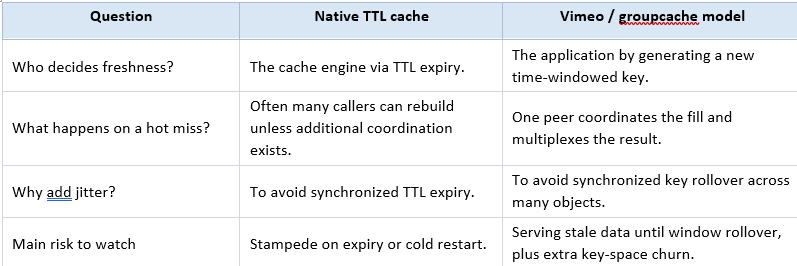
The architecture works because it separates two concerns that are often entangled. Groupcache answers the coordination question: who is allowed to cross the network and hit the database on a miss? The application answers the freshness question: when should a value stop being considered current?
That split lets Vimeo use a simpler cache engine while still enforcing bounded freshness. It also makes the design horizontally scalable. As peers are added or removed, consistent hashing redistributes ownership without requiring every instance to hold the same metadata, and a miss is still coordinated rather than duplicated.
• Freshness is approximate, not instant. A changed metadata record can remain visible until the current application window rolls over.
• The application layer now owns part of cache correctness. Key generation logic becomes part of the consistency contract, not just a helper function.
• Windowed keys increase logical key churn. That is acceptable when it buys simpler cache behavior, but it must be sized deliberately.
• Jitter is mandatory. Without it, time-window rotation becomes a scheduled avalanche.