Grammar / B1+ Grammar lessons and exercises / The … the … comparatives
The … the … Comparatives
🟦What Are “The … the …” Comparatives?
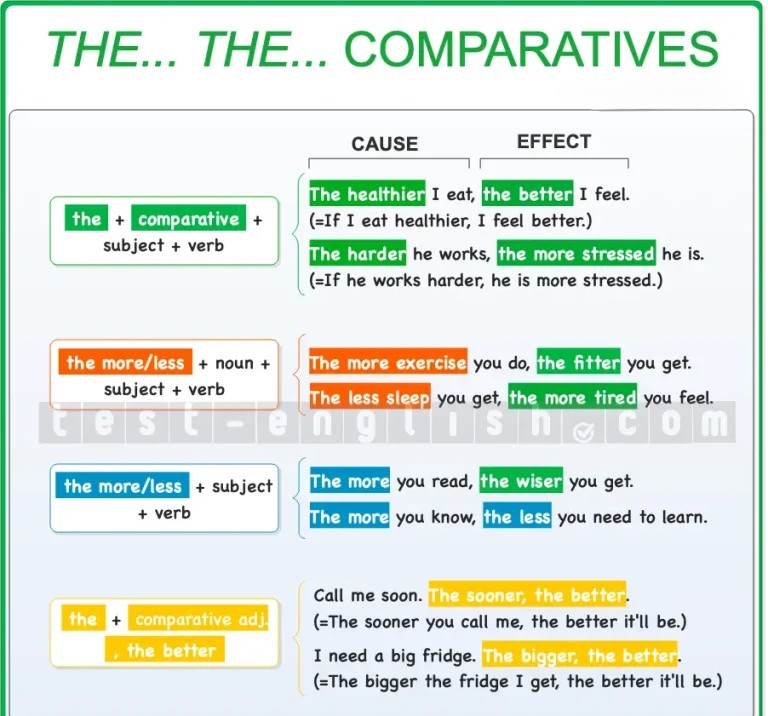
We use the + comparative …, the + comparative … to show a cause-and-effect relationship between two things that change together.
As one thing increases or decreases, the other does too.
✅ The healthier you eat, the better you feel.
(= If you eat healthier, you feel better.)
✅ The harder he works, the more stressed he is.
(= If he works harder, he becomes more stressed.)
🟩Omitting the Verb “Be”
When the verb be is used, it can often be omitted for conciseness.
✅ The longer the wait, the more agitated the people become.
(= The longer the wait is, the more agitated…)
✅ The higher the temperature, the faster the ice melts.
🟪The more / the less + Noun
You can use nouns instead of adjectives or adverbs.
✅ The more exercise you do, the fitter you get.
✅ The less carbohydrates you consume, the healthier you will be.
✅ The more money she earns, the more she spends.
🟦The more / the less + Clause
You can also use full clauses (subject + verb) after the more or the less.
✅ The more you read, the wiser you get.
✅ The more you know, the less you need to say.
✅ The less he sleeps, the worse his mood is.
🟨“The …, the better” (and similar)
We often use this shortened form to express preference or ideal conditions.
✅ Please call me soon. The sooner, the better.
✅ A: “Isn’t this fridge too big?” → B: “No, the bigger, the better.”
✅ The earlier we leave, the less traffic we’ll hit.
📌 Key Rules:
🔁 Structure: The + comparative …, the + comparative …
💡 Shows how two things change together (cause & effect).
➖ You can omit be: “The longer the wait…” (not “is”).
📚 Works with adjectives, adverbs, nouns, and full clauses.
✨ Common phrase: The sooner, the better.