Grammar / B1+ Grammar lessons and exercises / Zero and first conditional and future time clauses
Zero Conditional – Grammar Chart
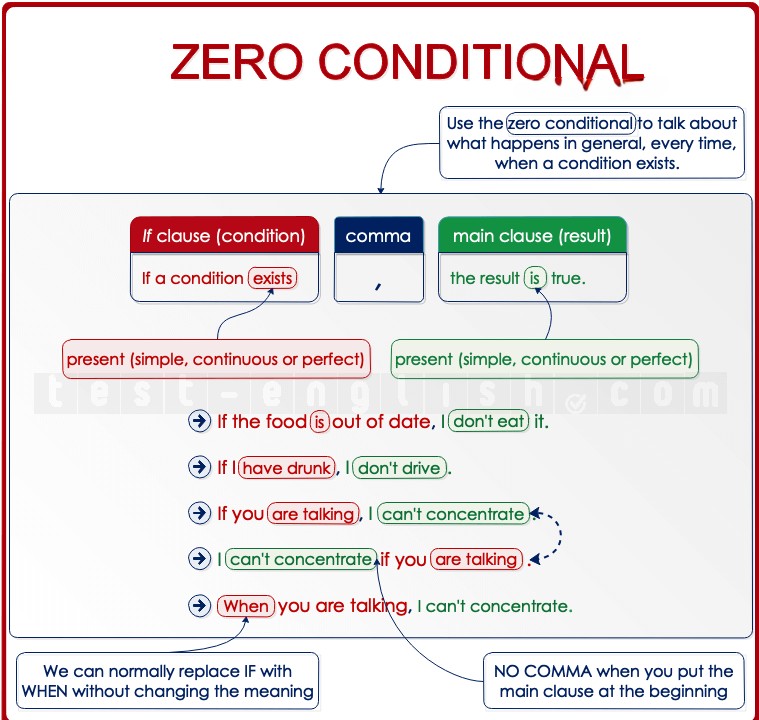
🟦What Is the Zero Conditional?
We use the zero conditional to talk about general truths, scientific facts, or results that always happen when a condition is met.
✅ If the milk smells bad, I don’t drink it.
✅ If water reaches 100°C, it boils.
✅ If people are talking all the time, I can’t concentrate.
🔁 Structure: If + present simple, ... present simple
💡 You can often replace if with when without changing the meaning:
“When the weather is bad, people don’t go shopping.”
🟩Clause Order & Punctuation
If the main clause comes first, no comma is used:
✅ I never go to bed late if I have to get up early.
First Conditional – Grammar Chart
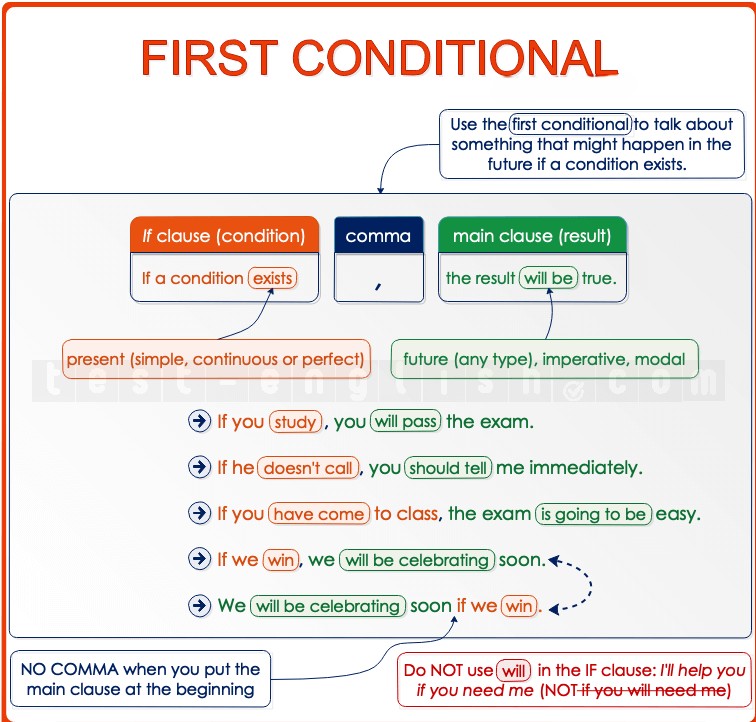
🟦What Is the First Conditional?
We use the first conditional to talk about real or possible future situations and their likely results.
✅ If you study, you’ll pass.
✅ If he doesn’t call you, tell me immediately.
✅ If you help me, I’ll have finished by the end of the month.
🔁 Structure: If + present simple, ... will + base verb
❌ Never use “will” in the if-clause:
❌ “I’ll help you if you will need me.” → ✅ “...if you need me.”
🟪Unless & In Case
Unless = if … not
✅ I won’t go on holiday unless I save money.
(= ...if I don’t save money)
In case expresses precaution (not condition):
✅ I’ll take my umbrella in case it rains.
(= I’ll take it whether it rains or not)
❌ NOT the same as: “I’ll take it if it rains.” (only if it rains)
Zero vs First Conditional
Zero Conditional
For general truths or habits.
“If you don’t use oil, it tastes awful.”
(= Every time — general rule)
First Conditional
For specific future possibilities.
“If you don’t use oil, it will taste awful.”
(= This one time — prediction)
Future Time Clauses – Grammar Chart
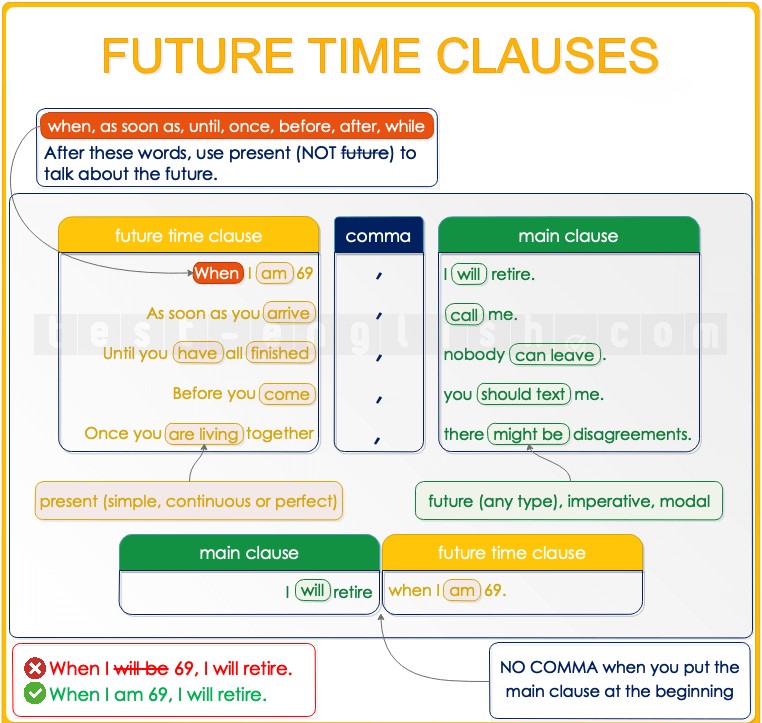
🟨Future Time Clauses
After time words like when, as soon as, until, once, before, after, while, we use a present tense (NOT “will”) to talk about the future.
✅ I’ll go to bed as soon as I finish my homework.
✅ When I am 65, I will retire.
✅ I won’t leave until you arrive.
🔁 Comma rule: Use a comma if the time clause comes first:
“When I am 65, I will retire.” ✅
“I will retire when I am 65.” ✅ (no comma)
🟩Present Perfect in Time Clauses
Use present perfect to emphasize that an action will be completed before the main event.
✅ I’ll go to bed as soon as I have finished my homework.
✅ I won’t leave until you have arrived.